Showing posts with label System Hacking. Show all posts

Wednesday, July 2, 2014

I Kissed a Pathfinder..and I Liked It (Pathfinder)


If you have been following this blog - and if you have, thank you! - you will be no stranger to my personal ambivalence towards d20 based games.

Why ambivalent? Well, like most of my generation, I started in this hobby by playing D&D; the original d20 game, back before d20 became a thing-unto-itself. So for me, d20 is the baseline by which all other games evolved outwards from. I can't really hate d20; d20 is my roots, after all. And within it are the basic building blocks for the hobby itself.

But...I've moved on, right? I have other, more advanced - more modern - game systems to play. Fate! Dungeon World! If I want a crunchy d20 game to play, I can spy Fantasy Craft right there on my shelf, waiting to be explored.

Plus, I've played a D&D 3.5 game, and I found the whole experience utterly lamentable. The basic problem was we had GM who was utterly committed to playing the game RAW with no exceptions: but really, if any game played RAW is a dull game, then it's just a bad game system. Right?

Right.

But...well, then there's Pathfinder. The sexier younger sister to D&D 3.5, with the beautiful art and presentation, with the legendarily well-written and flavorful modules ('Adventure Paths'), play-tested and fan-supported, all wrapped up in a cute little bow by local Seattle-area gaming studio Paizo.

Pathfinder always intrigued me. But not enough to play the damned thing. I flipped through the main book, and the modules, and the innumerable splat books with interest and appreciation..and then put them back on the shelf of my FLGS. Great stuff guys...but no thanks.

Flashback to 2012: looking for some gaming aids for my ongoing Fantasy Craft campaign, I stumbled across the Pathfinder Beginner Box. Complete with a playmat, some artful 'pawns' (cardboard miniatures), and set of dice, for just under $30.00? Sure..why not!?


And my gaming group used the hell out these tools: the dice rounded out my polyhedral collection well, and the map and pawns got plenty of use in our Fantasy Craft campaign. As for the rest - the character sheets and pregens, the Game Master Guide and Heroes Handbook- these stayed in the box as curiosity. Flipped through, but unread and unused.

Flash-forward to 2014. It's 8am on Saturday morning, and I'm packing up my stuff for Go-Play NW 2014. Gary has a supers game set for the day...but I've got nothing at all prepped to run. My eye spies the Pathfinder Beginner Box, and I think: sure, why not? If we have a spare moment during the day, I can run this. Easy-peasy.

Long story short: such a spare moment appeared, and I wound up running a game using the Black Fang's Dungeon scenario from the book. The result? I loved running it, and my group had a great time enjoying an old-school dungeon-crawl.

Before we go any further, note that I made some minor rules modifications before we even got started:

  • I failed to bring the playmat and minis, so movement and range were made to be largely narrative: Close (melee range), Near (penalty-free ranged attacks) and Far (ranged attacks at -2). Characters were allowed to move one 'zone' for free, or two by giving up an action.
  • Skill use was based on narrative justification: if you could justify the use of the skill, it was valid. If the book said 'Knowledge: Religion' was needed for the check, then 'Knowledge: Arcana' could sub as well.
  • Penalties for firing into melee combat? Attacks of opportunity? All narrative: the GM says when this stuff matters. If it slows things down or makes the experience suck..it doesn't matter.
  • You had to narrate what you were doing to do it. Attacking a goblin? Tell me how you are doing it! You succeed and kill a goblin? Narrate that shit: I want some cinematic flavor at my table, or it's all just boring numbers.

In short, I was running the game using Pathfinder mechanics to modify rolls, but acting like I was GM'ing a game of Dungeon World. And it worked like a dream, and fun was had by all.

What's the take-away from this experience?

For me, it's that any game system can be fun, provided that everyone - players and GM included - are committed to having fun. The minute that any rule gets in the way of that, that rule should immediately be abolished or ignored. 

Secondarily - but just as important - don't ever think of the players as agents that derail your story. They are there to contribute to the story. The players will do things not imagined by you or the module's designers: in this case, improvise!  

In the case of this module the scenario suggested either a resolution as a physical conflict or a diplomatic one: in reality, it was both with the players slaying King Fatmouth and interrogating a charmed goblin;  I chose as GM to provide the 'diplomatic solution' info via the charmed goblin, as this seemed the logical reward to this cautious approach. The story was thus adjusted based on player initiative, rather than being derailed altogether. 

So will I be running more Pathfinder games in the future? 

Sadly, the answer to this seems to be 'no'. My gaming group prefers the flavor found in newer - and more narrative, and flexible - game systems like Fate: as soon as I suggested we play Pathfinder ongoing the conversation led to talk of Fate Freeport being used for fantasy gaming. Which is great: I loves me some Fate gaming.

So for now, Pathfinder will have to live in inside of it's little Beginners Box, unloved and hardly played. But we did have a moment, once.

And I liked it. 

***

Wednesday, January 22, 2014

Four-Color FAE: Supers Gaming via Fate Accelerated - pt5

The saga continues! I this post, I suggest a new rule for FAE that grants a Fate Point when an action is denied due to an aspect that grants immunity.  
This is largely inspired by a similar mechanic in Mutants and Masterminds that grants Hero Points under similar circumstances. 
Part 1
Part 2
Part 3
Part 4

***
Aspects and Immunities in FAE Supers

It's a common scene in heroic fiction: the hero attacks the Big Bad, only to find the villain completely unphased by his best efforts.

"Your attacks are futile against my (fill in aspect here)!"

This is fun, and is great for building a story where the heroes face insurmountable odds only to overcome the opposition through perseverance, creativity, know how...and a little luck.

But as a player experiencing this, it not fun at all. You just wasted an action that could have been used doing something productive (like creating an advantage, or overcoming an element aiding the villain) on a useless attack action followed by ritual belittlement.

To offset this, I am proposing the following rule; the first time that an immunity aspect is 'invoked' in a scene (this is a free invocation, as the aspect is already true), the opposing party that prompted the invocation is paid a Fate Point.

This sweetens the pot a little bit, doesn't slow down the game, and doesn't break the Fate Point economy. It also creates a cost for taking immunities; you are potentially granting a Fate Point to the opposition that they will surely use against you in other ways.

***

Tuesday, January 21, 2014

Game Theory: What's on the menu?

Say what you like, Pathfinder's got Class

It's 1985, and my friend Brian (a huge fan of the newly published Dragonlance novel, Dragons of Autumn Twilight) convinces me to purchase the D&D Red Box at the local Toys "R" Us so we can play a game with a similar cast of characters that he had come to love in that series.

Getting back to his house with our newly obtained loot, we open up the box and start reading (after marveling after the odd dice and little crayon included, along with the map). 

We start with the one marked Player's Manual, as it is inscribed with bold yellow letters saying: READ THIS BOOK FIRST! The color, the fact that it's in all caps and with the added '!' indicates that this is an important prerogative, so we dutifully comply. 
Immediately we find that the book gives us a series of options to play characters; this is not some free-form improv-theater piece where you just make up a guy and bluff your way through. It's hard-coded with options that reinforce what sort of characters are expected to appear as protagonists are expected to appear in this world. These options were:

Humans (Yay! We are human, and we get to pretend that we are other humans!)

  • Cleric
  • Fighter
  • Magic-user
  • Thief
Demi-humans (Yay! We are human, and we get to play things that are almost, but not-quite human!)

  • Dwarf
  • Elf
  • Halfling
Now, I had bought this game to play a Magic-user - since magic is cool - so I knew immediately what 'Class' of character I wanted to play already (although I looked REALLY hard at the Elf as a option. He gets to do magic AND he's good at fighting? Money.)

So I rolled up my character as per the book, didn't get a high Intelligence (which the book said I HAD to have to even play a Magic-user), so Brian and I agreed that it would be OK to switch some numbers around to facilitate that. 

Time from reading my first RPG to hacking my first RPG? About 1 hour.

From there I picked out a few weak first-level spells, choose some languages I knew, a bought some gear with what little money I had from the gear list, and went into my first dungeon (and somehow survived it, which is a wonder to this day).

Looking at the most recent version of D&D today, although a lot has changed (Elves and Dwarves and Halflings are still there, for example, but they are no longer 'Classes') the fact remains that the system is still very much menu-driven: rather than being given limitless options to make the character you envision, instead you are given a 'menu' of options to choose from, and build around that. 

You choose:
  • Your Race
  • Your Ability Scores
  • Your Class
  • Your Skills, Feats, Powers, and Equipment (as appropriate for your Class)
  • Your Alignment
Once this is resolved, voila! You are ready to do some D&D. 
Make sure to fill in all the circles, please.
As per the original D&D, the 'menu' concept continues from there as you play; as you gain Experience Points (the meta-resource for the game that enables you to gain new abilities), you are given new options to build upon your abilities. But as offered in character creation, the decision-tree presented for advancement is determined by the original choices you made for your character when you started. The choices you make simply offer new sub-menus with limited numbers of new options you can add to your character.

Every RPG system to date has some form of menu available to choose what sort of character you are playing, and what they can do well or not-so-well. Some of the lists can be bigger and offer more choices than others (GURPS, for example, has a mind-boggling number of options right out of the box), and some smaller (indie-darling Dungeon World has a relatively small menu to choose from vs 4e), but there is still a menu regardless.

Why is this? Why do we want or need a menu at all? Why can't we just say: 'Here's my character, this is what motivates him, and this what he is good and bad at', and hit the gaming table with that?

Well, menus do a few key things for RPG's:
  • Menus reinforce genre. Having a game where the options include Cleric, Wizard and Fighter but does not include something like 'Cyborg' tells us a lot about the world the characters are expected to appear in.
  • They also help define Party Roles, which is important for team-based play; a state assumed by 99% of the RPG's on the market.
  • Menus (in theory..) promote game-balance. By clearly defining what sort of abilities can appear on the table in any combination, you can limit Mary Sue-ism and reinforce party roles, as above.
  • Having a menu also helps players to decide what sort of character they will play by defining what sort of character is allowed in the game. If you have no clear idea of what sort character you want or what traits they should have, having a limited list to choose from is of help.
But it's not all gravy. Menus also limit you in some key ways as well:
  • They limit your options. Want to play a Fomorian princess-in-exile who can cross between the Otherworld and our own? Too bad; that's not in the book. 
  • They limit imagination. You want your wizard to cast a huge spell that impresses the frost giants into aiding your cause? Too bad; you have nothing that allows that on your character sheet. Think of something else.
  • They can also create the bizarre netherworld of 'Character Optimization'; a term that comes up often in reference to D&D 4e and her prettier and more popular sister, Pathfinder. Just because you have more than one option to choose from when creating and advancing your character doesn't mean that they are all equally useful. Which segueways us well to the next issue...
  • Menus promote samey-ness. If my optimized fighter with optimized gear looks just like your optimized fighter with optimized gear at Gen-Con, it's like two girls in the same dress at the prom. Neither one of us looks very unique or interesting next to the other. 
My current interest in more 'rules-light' systems like Fate or Heroquest is not because I hate all-the-damned-rules; I've happily played and run games with all-the-damned-rules just fine, thank you very much.

The main appeal for me is that these sort of systems allow me to play what my imagination summons up without having to either hack the system, make my own playbook from scratch, or ignore some rule to make it work. In other words; I have the freedom to order something not on a menu.
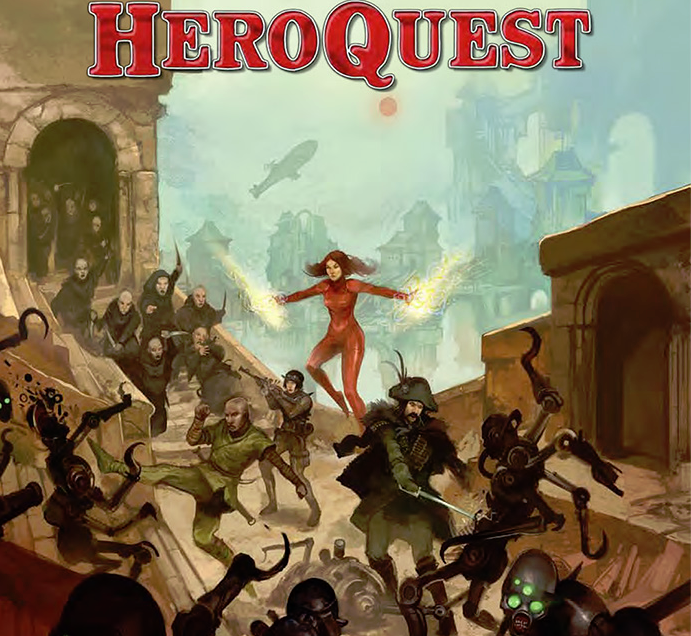
Dagger-wielding cultists, evil robots, and a zeppelin? Huh, guess it's Wednesday already.
As a GM, I have always had the freedom to make my NPC's as I like with just about any RPG on offer. But as a player I want to have that same freedom when making and advancing my character, and as GM I would like my players to have that same freedom as well.

Note that this sort of freedom is not by necessity limited to 'rules light' systems either; Mutants & Masterminds grants a massive number of options for character creation, and allows the player to pre-flavor them as desired, as does the ever-popular Savage Worlds (although Savage Worlds could be described more as 'rule-medium' at worst).

It's no secret that my current RPG drug-of-choice is Fate. I've been tinkering with it since I first discovered it as FUDGE-hack, and for the same reasons noted above; because it allows me to make the character I want to play at the gaming table straight-out, and not some compromise that some distant game-designer thought I might like to play; nor do I have to wait until I've reached some arbitrary 'level' to play them.

In Fate, for example, if I want to play a wizard with Hands burned by the cold fire of the underworld, who has Shadow-demons that respond to my whispered commands, I can. No hacking required; just add those Aspects, some Skills or approaches to reinforce this, and maybe some Stunts and/or an Extra to back it up, and 'boom!': I'm ready to do some Fate.

For me, this is all-kinds of awesome. I'm now given permission to play what I want at the gaming table, and my friends are as well. 

As noted above, however, there is a trade-off here; by abandoning a menu-based system we have opened the possibility for confusion. With no road-map, with no clear path to create characters, we are now largely left our understanding of the system to create characters; and this is often a scary path for new players and even new game-masters.

In many ways this is the main failure of Fate Core in particular; by not providing a good number of examples for creation of characters (something I think Savage Worlds and Mutants & Masterminds in particular does well), new players are largely left adrift at sea when making sense of what the system can do. That's unfortunate, and I hope that some of my posts here might assist in that regard.

That being said; despite the difficulties involved, for me the effort is worth it to make the characters we want to play appear at the gaming table.

It may be the chef's (game-designers) pots, pans and range we are using, but we get to pick the ingredients now. And we have free-run of the kitchen:

So let's get cooking.

***

Monday, January 20, 2014

Four-Color FAE: Supers Gaming via Fate Accelerated - pt4

Continuing my series about supers gaming in FAE, in this post I discuss the use of Extras with my group.
Part 1 here.
Part 2
Part 3

***
Extras in Fate Accelerated
Just where does he get all those wonderful toys?
You may note that in all of my builds I devote an area to Extras for each character.

In Fate Core, Extras are largely objects or powers that expand the scope of character abilities beyond the standard options offered in Chapters 1-10.

But in Fate Accelerated, your character aspects can do that by themselves.  So what are 'Extras' in FAE?

Exactly that: extras.

Batman is still Batman without his Batmobile, or his Bat Plane, or even without the Batcave. He has these things even without needing them as his core (his main five) aspects.

But without them, the Bat has no way to get where he wants to go, and nowhere to rest when he is not in action. So although these items may not be essential, they are part of the character's mythology and are worth noting.

In short: Extras are there to round out your character. You may start with 0-3 as your starting character, and acquire more in play.

In brief:

* Extras are aspects, and work as other aspects do.
* Extras are fragile; they are things that are subject to change or even being lost in play.
* Extras are never character-defining. Captain America's van is an Extra: his shield, however, would be one of his five main aspects.

We will talk more about Extras during character-creation, including the possibility of adding team extras to add some flavor and expand the options of the group.

***

Saturday, January 18, 2014

Four-Color FAE: Supers Gaming via Fate Accelerated - pt2

In part 2 of this series, I discuss character roles in team-based superhero characters with my group. 
Part 1 can be found here.
****
 Character Roles in the Supers Genre

Team-based supers tend to differ from characters that guide their own books in a key way: team-based heroes tend towards a particular role in the group that allows them to stand out when facing specific challenges.

Even when characters like Batman or Superman (who normally operate solo) are added to a team like the Justice League, they are usually simplified to fill particular roles within their respective teams.

A good supers team is therefore like a good D&D party: each character brings something to the table to round out the strengths and weaknesses of the others.

Let's view the classic Silver Age hero team The Fantastic Four through this prism:

Thing - Fighter/Tank (Peak: Forceful)
Invisible Girl - Rogue (Peak: Sneaky)
Human Torch - Ranger (Peak: Flashy)
Mr. Fantastic - Wizard (Peak: Clever)

Individually, each of these heroes only brings one main approach to the table that they are particularly good at. Each might therefore be considered a minor-level hero. But together, they are able to handle cosmic-level threats with ease. A great, well-balanced team. Which I think goes far to explain their continued popularity after five decades worth of stories.

When creating characters for our game, regardless of the powers and backgrounds we choose, it's good to consider:

* What strengths does this character bring to the table? What are their weak spots?
* How do our characters work together as a team?

Many of these questions will be answered in play as well, of course. But thinking about them during character creation will help us to create a strong base to build upon as we find their individual stories.

***

Friday, January 17, 2014

Four-Color FAE: Supers Gaming via Fate Accelerated - pt1


Roughly four months after posting my first supers build (and my first Google+ post!) using Fate Accelerated, I'm finally going to be running my first supers game using the system here in Seattle. 
Needless to say, I'm stoked!  
To introduce my players to my concepts using the system, I have been posting a series of 'primers' to our game community. Seeing as they might be of use to others as well, I am also sharing these to the site. Note that I will be covering some of the same ground covered by earlier site posts, but specifically tailored to what the system brings to a supers game.
***
Power Facts in Fate Accelerated

As in all Fate games, the most powerful aspect of Aspects is the ability to Establish Facts:
http://fate-srd.com/fate-accelerated/aspects-fate-points#establishing-facts

In our game, these are often expressed with Power Facts: truths about the character's powers.

Although these facts do not change the effectiveness of the uses of Approaches (your approach level and stunts impact that), the scope of what you can do is largely impacted by your Aspects, as defined by power facts.

Let's look at Miss Martian, whose character sheet appears in the link.


Her power facts state that as a Martian she has the following abilities:
  • Shape-shifting: She can change her form, completely altering her physical appearance, including her organic clothing, allowing her to mimic other people as well as adapt to different environments.
  • Malleability: She can extend her limbs into large whips to grab things at great distance.
  • Healing: Her shape-shifting allows her to heal faster than a human would. 
  • Camouflage: She can change the appearance of her form (and her clothes) to match her surroundings, but she is not completely invisible.
  • Super strength: Like all Martians, Miss Martian has strength above that of a typical human.
  • Telepathy: Telepathy comes naturally to Martians. She can create a telepathic link with her teammates, which makes communications easier and untraceable. Megan can also telepathically connect with her Bio-Ship.
  • Multilingualism: Megan can speak Martian and English. She can also translate languages psychically. 
  • Telekinesis: Megan can use telekinesis to manipulate many objects with her mind. However, she can lose control when moving too many objects at once or not paying enough attention. By telekinetically moving herself, she can simulate flight. 
  • Heat/Fire Sensitive: Miss Martian can be weakened when exposed to direct heat or fire
This is, to be fair, an overwhelmingly MASSIVE list of abilities, all granted by a single aspect. Surely this is broken character compared to someone like Robin who is limited to what his wits and agility alone allows him?

Yes....and no. As noted above she is still limited in the use of all of these abilities by the strength of her approaches and stunts, just like any other character.

This is the beauty of Fate in many ways: even with all of these vast powers she is ultimately using the same four actions available to anyone else, and is no stronger in general at them than anyone else. It's just the permissions of what these actions can mean narratively is expanded by her powers.

When we get to making characters in our game, the following questions should be addressed:
  • What can your powers do?
  • How do they work and/or why can you do these things?
  • What limits can be compelled on them?
As long as the three questions above can be answered, you have created a great set of powers for the game. :-)


***
Next up: Approaches vs Skills in Fate. In the interim, feel free to check out the Miss Martian build below via Google Docs.

***
Miss Martian (Google Docs)

Thursday, January 2, 2014

Character Highlight: Balsa, Spear-Fighter of Kanbal (Fate 2.0)

Ah, January.

Named after the Roman god Janus, the god of beginnings and transitions. Depicted as having two faces, since he looks to the future and to the past.

In his honor then, as we now all look forward to the new year of 2014 I am taking this opportunity to look back into the past as well: to the first published version of Fate (then called FATE 2e) back in year 2003.

This was the first version of Fate that I read, and the first that I attempted to hack. Even back then, the system was very much designed to be hacked, with multiple possible rules variants and advice for keeping things light and moving forward. For example, when discussing setting difficulties as the GM (sidebar, pg. 15):
"When all is said and done, setting difficulties is more art than science. While it is possible to provide guidelines for what reasonable difficulties might be, the GM will eventually find herself in a situation where she is going to have nothing to go on but her best guess.  
The urge in those situations is often to take several minutes to dig through the rules, looking for some explicit ruling - RESIST THAT TEMPTATION! We'’ve written the book, and we can assure you that rule is not in here, so trust yourself, and use your best guess."
 This reads rather refreshingly like a piece of advice that might appear in Fate Core ten years on. So although the particulars might change, the Core of Fate - being the philosophy that guides it- remains the same.

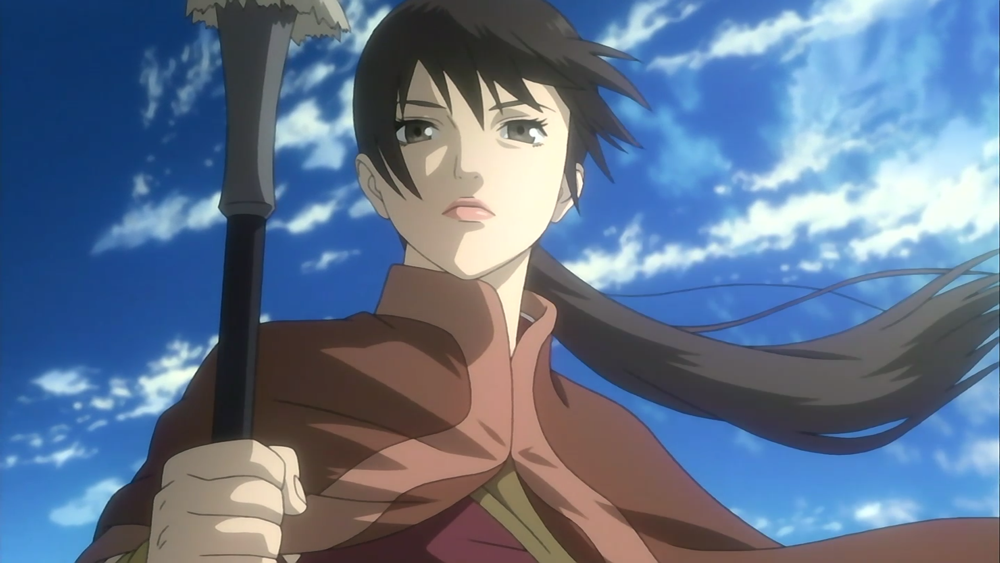
Looking through my old builds for Fate 2.0 today, I found one for the character Balsa from the anime Moribito, Guardian of the Spirit:

http://moribito.wikia.com/wiki/Anime

I won't post that build here: I am sure that the readers of the blog have certain standards, and my early builds were rather poor. But in the spirit of looking back as well as looking forward, here she is built using FATE 2.0 rules fresh for 2014:

Balsa, Spear-Fighter of Kanbal (Fate 2.0)
Aspects
  • Bodyguard for hire: O
  • Jiguro trained me..reluctantly: O
  • I’ve vowed to redeem eight souls: OO
  • I know people everywhere: O
Skills
+3 Melee
+2 Athletics, Unarmed
+1 Awareness, Endurance, Impress
+0 Deceive, Languages, Lore, Riding

Fate Points: 3
Goal: "I will protect my charge."
Outcomes:

  • Scratched (0):
  • Clipped (1): OO
  • Hurt (4): OO
  • Injured (6): OO
  • Taken Out (7):
Background

A skilled warrior from the faraway land of Kanbal. She is 30 years old.

Balsa is pragmatic and intelligent and she does not hold much regard for class distinction customs. Despite her deadly skill with a spear, Balsa tries not to kill in combat. As a result her body is covered with scars.

She is the daughter of the former Kanbal King's physician who had discovered that the new King had poisoned his predecessor. Worried that his crime would be revealed the new King ordered the physician and his daughter, Balsa, be executed for treason.

To protect his daughter the physician asked the one warrior he could trust, Jiguro who was the first of the King's 9 Spears, to take her and run while he stayed behind. Unfortunately the King sent the other 8 Spears (while holding their families hostage) after them. Her guardian was able to protect her but had to kill all 8 of his former comrades to do so.

Later he taught Balsa how to use a spear responsibly after seeing her perfectly re-enact the moves she'd seen him use.

Although Balsa claims to be a simple bodyguard-for-hire; in reality she wields her spear in order to save lives in atonement for the eight lives that were taken to protect her when she was a child. 

***
FATE 2e PDF

*Edit 01/03/13 - Updated with character Goal, since I forgot it in my original build.