Showing posts with label Review. Show all posts

Friday, August 8, 2014

Review: Jadetech - Green Jade (Jadepunk, Fate Core System)

Authors: Jacob Possin, with flash fiction by Benjamin Feehan
Cover Artist: Nicole Cardiff and Jesse Ferguson
Format: 16 page, bookmarked PDF (14.4 MB)
Site: http://www.rerollstore.com/collections/jadepunk/products/jadetech-green-jade-pdf 

***
Overview

Mike - Before talking about the first Jadepunk supplement, Jadetech: Green Jade, let's talk a bit about MERPS (Middle-Earth Roleplaying System by ICE, Circa 1984-1999).

Reagan - Wait, what?

Bear with me a moment: there is a point to all of this.

MERPS is a wonder of 1980's RPG design: although a 'rules light' version of the ultra-crunchy Rolemaster engine, it is still ultra-crunchy beyond all comprehension compared to most modern systems.

This crunchiness extends to all aspects of the game: where Tolkien provided only a few lines of flavorful text, MERPS provides pages upon pages of detailed information, maps, character traits, stats, and tables. It takes the broad brush-strokes provided by the original creator's hand and fills in the fine details: ample fodder for the detail-oriented GM to set the scene in any possible scenario of a Middle-Earth based game.

So what does this have to do with the Jadetech: Green Jade supplement?

Well, herein we find the opposite approach employed; as in the main book, this expansion paints with a broad brush. It is about showing, not telling; it provides stories and flavorful examples.

This is a key point to talk, not just about this supplement, but the Jadepunk line in general. The majority of RPG products seem to follow the model of presenting the game rules and interspersing narrative and setting details in the sidebars and example text. Crunch over Fluff, if you will. The Jadepunk setting is well-written, full of flavor, and its obvious that a lot of time has been spent imagining what the society around this jade technology looks like.

Green Jade is the same in this respect, and I think its the right approach for the setting. Much of the mechanics are relegated to sidebars, to accentuate the narrative text. What text is devoted to mechanics reads as much as a suggestion on how to use it in a broad sense as opposed to actual mechanics, and I like it! Not only does it provide more space to reveal why the Jadepunk universe is the Jadepunk universe, but it allows GMs the option to mechanically flavor how green jade is both used and influences the game world however that GM likes. Bob's your uncle!

It shows some fine examples of green-jade gear (using the Assets build system found in the main book), it tells stories of the use of green jade in the game-world. No maps. No tables. No stats, apart from a few sample Assets. Instead, it paints a picture, and presents these pictures as fresh inspiration for your own campaign.

And it doesn't provide much in the way of new mechanics: the only mechanical addendum is the replacement of the 'secret' aspect with the 'instinct' aspect for creature NPC's. This is more of a tweak than a truly new mechanic. In conjunction with this idea, the book presents the idea of 'chaermera': animals enhanced in toughness and/also size by exposure to green jade.

Chaermeras are great - yet another example of how jade influences the overall gameworld. Given that Jadepunk was conceptualized originally as 'What if we mashed up old we-st gunslingers with wuxia heroes?' - you can see just how much the authors explored jade's societal impact.

With it's small size (16 pages total, including the back/front cover & credits page) and low price-point ($2.99 USD for the PDF at DriveThru RPG), Jadetech: Green Jade reminds me of the Gadget Guide and Power Profile PDF's for Mutants and Masterminds 3e

Like these guides, it is available as a low-price point PDF; and also like these supplements, it presents little - if anything - in the way of new rules; instead, it shows you how to use these rules to build new and wonderful things for your own game. Considering publisher +Ryan M. Danks publicly confessed love of Mutants & Masterminds, I can only assume that these parallels are the result of inspiration/emulation rather than coincidence.

You get a lot for $2.99!
Buy or Don't Buy?

Like Jadepunk itself, this supplement provides a beautiful and easy-to-read presentation. Also like the main book, it gives all the flavor you need about the subject at hand while providing plenty of whitespace to make it all your own.

But is it worth your hard-earned gaming dollars?

Well.... at US$2.99 for the PDF, it's basically an impulse buy. So I would think that price-point is hardly an obstacle for most. On the other hand, most of the beauty that the book presents will live on your computer/tablet screen only, unless you have the option of making a HQ printout.

  • Buy if: You love Jadepunk, and would like most examples of the setting and it's flavor for your table. Plus, it presents some great sample assets to use in play, or to inspire some of your own creations.
  • Don't buy: If you are using Jadepunk rules to run a generic campaign, there isn't much here for you. The chaemera rules might be of use to you for building beast-type NPC's, but I basically already spoiled that already in this review. On the other hand.... it's $2.99. You might want to download it anyhow for the read alone.

Final Word

Although this is a wonderful supplement- kudos to +Jacob Possin & +Benjamin Feehan for your lovely work here - this really isn't the Jadepunk supplement that I truly want.

I want mountains, Gandalf- mountains! I wish to know more about the larger world sketched in broad detail in the main Jadepunk book. Tell me more about the Cairn Mountains of Aerum; inform me about the Funarino Channel of Kaiyu. I'd love more on the history and conflicts between the major mining companies. Tell me about the honored traditions of the Nottila ship-captains! Show me how to run a game set in the fronteir-era of Kausao City, when the different powers jockeyed to see who would control the black jade of the Xibu Bati mountains. The Aerum Empire has airships!

I know that there are adventures to be had in Far Harad: tell me what I might find there. I want to know all that you can tell me.

But I have every faith that all of this - and more- will be explored in further supplements. And I cannot wait to see what Reroll Productions has in store for me going forward.

****
Jadetech: Green Jade (Reroll Store)


Tuesday, July 8, 2014

Review: Tianxia (Fate Core)

Format: Hardbound Book/PDF: 192 Pages
Publisher: James Dawsey
Author: Jack Norris
Art: Denise Jones
Map: Marco Morte
Editing: Nathan Kahler
Art Direction and Graphic Design: Daniel Solis, with Ruben Byrd
***

Launched via a successful Kickstarter campaign in October of last year (it seems like this is how you launch RPG's nowadays...), Tianxia is a wuxia setting and rules supplement for Fate Core.

Although I was instantly enticed by the style and presentation presented in the Kickstarter - the art especially, as the art is gorgeous..more on that below - I dawdled on contributing until November, and didn't really examine the PDF at length until about a month ago.

My thoughts in brief: if you already own Fate Core and you want to play a high-octane wuxia game, you owe it to yourself to at least check it out. If you are new to Fate and just want to play a wuxia game that supports all the tropes, then you should still check it out.

More details as to the why of this in my review below.

  • Presentation & Layout

My thoughts on Tianxia very much parallel what I had to say about Jadepunk in my review of that game earlier this year: this is a beautiful and beautifully laid-out book where the design really sells the genre and flavor of the game on every page.

This is also one of the blessed few RPG books where the reader is rewarded by reading it cover-to-cover, like a storybook: and indeed, we are given the story and flavor of the world of Tianxia well before the author presents the hard mechanics that make things work in play. 
  • Setting and Background
An except from the book sells the basic idea well:
"Tianxia (“under heaven”) is a series of rules and setting supplements for the Fate Core system. 
The title of the game comes from both the concept of all the lands and people in Imperial China existing under the purview of the gods and their celestial kingdom and the term used for the imperial unification of kingdoms and cultures to create a central “China” that had previously not existed. The films Hero (Jet Li, not Dustin Hoffman) and The Emperor and the Assassin present fictionalized but highly entertaining versions of how that unification began.  
Just as Tianxia the concept was supposed to include everything that existed “under heaven” in real world imperial China, Tianxia the game includes everything in our rules and setting materials heavily inspired by Chinese myth, legend, and modern media such as Kung Fu and wuxia literature and film."
What follows is a pastiche of what is the 'standard' setting for a traditional wuxia adventure: Jaingzhou, the wild west of this fictional version of China. The book explains that this is but one of the nine-provinces of Shenzhou (which itself is but another name for China), the other eight being promised in greater detail in later supplements.

Far from the grip of the capital, rule of law in Jaingzhou province is more of the 9/10th of the law variety: if you can hold it or steal it, it's yours. This is a place full of bandits, secret societies, corrupt officials, private security services: a land of corruption and injustice. A place badly in need of heroes.

In short: the perfect place to have adventures!

Everything you need to run a full campaign is here: loads of named NPC's, locations, and organizations to power your game: but enough white space to make it all your own.

Where the flavor text and character stats end, various sidebars inform the philosophy of the game designers, discussing matters like creating an inclusive gaming environment, possible adventure hooks and story ideas, and even the traditional role of eunuchs in Chinese culture and legend. All dandy here.
  • Rules & The Deadly Arts of Kung Fu
Although Fate is often presented as a 'story game', Fate Core in particular has a lot of bits to define character competency via Skills and Stunts. Tianxia expands upon this by adding a new Skill, 'chi', and a new way to build martial arts abilities via the Forms system.

An important note here: although it does contain 192 pages of wuxia goodness, Tianxia is NOT a complete game system. You very much need Fate Core to play it and build complete characters: even the action resolution tables are missing from the book.

As stated in the intro, I participated in the Kickstarter and was already playing Fate Core when I picked this up, so this wasn't an issue for me. But this basic point is not mentioned in either the front or back covers, and appears for the first time under 'What Is This Book' at pg.16. I can easily see a new gamer overlooking this factor, even upon relatively close inspection.

So if I picked up this book after flipping through it at the FLGS and discovered this when I got back home and not already in possession of Fate Core..I could imagine being a tad upset. Maybe a niggling point since Fate Core is currently a 'pay-what-you-like' (including nothing) PDF download, but it's my one complaint about the physical book.

But let's talk about the good stuff!

In addition to the 18 Skills presented by Fate Core, Tianxia presents a new one: Chi, the quasi-mystical force that represents the body's flow of energy. The actual concept of chi (or 'ki', or 'qi') is complex and tied to Chinese Daoist thought...but here it's a kind of super-power that gives characters greater physical/mental endurance and recovery abilities, as well as expanding what the character can do in conjunction with their Forms and Stunts.

Forms are really neat. For those already familiar with Fate but not Tianxia in particular, it's best to think of Forms as specialized (and discounted) Stunt packages.

For example: the character Smiling Ox (character sheet below), is trained in the Iron Tiger Form. Per the book:
"The dreaded Iron Tiger practitioner is thought to be one of the most aggressive, lethal fighters around. 
What Iron Tigers lack in maneuverability and flexibility they make up for in physical power, toughness, and aggression. This style eschews many of the tactics and principles of softer styles to focus purely on hard-hitting blows, disabling strikes, painful locks, and linear but effective defenses."
Each form is also an aspect that can be invoked/compelled like any other aspect in Fate. Taking a form has cost involved, in terms of Refresh (your starting Fate Points): one point of Refresh (or Stunt slot) gives you the form and one Technique (worded as pre-generated Stunt). Each additional point of Refresh spent on the Form grants two more techniques.

Like the Iron Tiger Form above, all Forms consistent of a element (Iron, Storm, Forest, etc.) and an animal (Tiger, Monkey, Dragon, etc) that flavors and informs your martial arts style.

There are additional rules that grant certain benefits when you master certain Forms, which I won't get into here. Bottom line is: although this is an optional system for character creation, I cannot imagine NOT taking a Form if you are playing game where physical conflicts are going to come into play. They are just too powerful to be ignored.
  • Sample Characters and GM'ing
The GM'ing section starts out sprightly, with a handful of sample characters emulating certain tropes (I recognize Detective Dee and Princess Mononoke as templates- I'm sure more informed readers will spot others). This leads into a sample play session starring these characters, to demonstrate how Tianxia character builds work in play. 

This then leads into the standard GM advice section, some comments on legendary weapons (standard Fate rules: if gear is important to the story, model it. If not, it's just flavor), story advice and more plot seeds, and a 'bestiary' of standard and exceptional NPC's that can be encountered in play. 

All of this is followed by four simple - but well-plotted - two page adventures to run your new characters through.

Like the rest of book, these sections are presented in informative (but not authorial, in the bad sense of the word) way, and all the material is easy and fun to read to boot.

  • Inspirations and Afterword
Much of the final 20 pages or so (about a tenth of the book!) are taken up by listing inspirations from films, books and video games. At first blush this might seem like an excessive use of limited space, but it's clear that the author (Jack Norris) wants to provide this because:
  •  It's good to know where he is coming from in terms of game-design and play
  • He wants you to have plenty of sources of inspiration for your game as well.
For my part, I've seen four of the eleven listed films, am familiar with (but have not read) two of the four listed books, and I've played two of four listed games. Personally I would have added the two Zu Warriors films to the mix, as well as Iron Monkey: but it's not my book.

Author Jack Norris' afterword is nice too, noting his personal journey to finally getting this game published after a decade plus. This has clearly been a labor of love for him, and this absolutely shows in the finished result.
  • Final Thoughts
So the book looks nice, has great content, and an interesting system to build kung-fu powers: but does it work well in play?

Well, I've recently been GM'ing a game using the system recently and I can give the affirmative to that: abso-friggin-lutely yes it runs great in play! My players have been having a fantastic time exploring their various kung-fu powers, and as GM I've had a blast coming up with scenarios to challenge them.

Now, this is still Fate - the roleplaying aspects of portraying characters at the table are still important - but thats true of any good RPG, Fate included. What Tianxia brings to the table are the extra bits, and those extra bits are fun and don't bog down gameplay at all.

Is it worth your gaming dollars? Well....that depends. It's a nice coffee-table book - the art and presentation are great, as noted above - but at $44.95 (USD) it's pretty steep investment for a book that won't ever be played. And this is a game that wants to be played.

If you are already gaming with Fate Core and have been thinking about playing a wuxia game: then yes, it's worth the investment. If you prefer playing from PDF's (or just don't want to pony up for the hardback), then that's just $14.99 on DriveThruRPG. 

If you aren't familiar with Fate Core but think playing a high-octane (but still story-driven) wuxia game might be fun, I would suggest you download and read Fate Core first (available as pay-what-you-like/free price-point), before investing in either the PDF or the hardback for Tianxia. Tianxia takes what Fate Core offers and builds on it: if you don't like or grok Core, you will have the same trouble with Tianxia.

***

More on the blog soon about our Tianxia game here in Seattle: The Kingdom of Xinjou!

***

Wednesday, June 18, 2014

Review: Jadepunk (Fate Core System)


Jadepunk: Tales From Kausao City
Authors: Ryan M. Danks, Jacob Possin, and Mike Olson
Cover Artist: Conrad Javier
Format: 139 pages, softcover
ISBN: 978-0-615-98624-1
Website: http://jadepunk.com/

****
Funded by a successful Kickstarter campaign started summer of last year (2013), Jadepunk is yet another of the gaggle of Fate-based RPG's to appear since the wildly successful launch of Evil Hat's Fate Core in 2013.

All of this reminds me of the plethora of d20 based games launched with the advent of the OGL in the early 2000's, with similar results: a handful of great games launched using a basic universal system, and a lot of also-rans.

So where does Jadepunk fit into this equation? In my opinion it fits neatly into the 'great' category, for the reasons outlined below.

***
Presentation & Layout

First impressions: Jadepunk is a beautiful book. While there isn't art on every page, in all places there is a degree of artistry: from the use of genre-appropriate (but still very readable) fonts, to the ink-splashes and 'torn pages' effects that sub for the additional info boxes in Fate Core and other RPG's, the presentation throughout is slick, artistic and easy-to-read.

Where interior art does appear (provided by Nicole Cardiff, Conrad Javier, & Kurt Komoda) it ranges from good to absolutely excellent; some of which you will see scattered throughout this review. This is a book from an indie-press publisher and this is their first product: but you sure as hell cannot tell that by looking at the end result.

In fact, I think that some better established publishers should look at this book for an example of how to properly sell your game through sheer presentation. No complaints at all in this department.


Introduction + World of Jadepunk 

If you've read Fate Core, or more to the point Fate Accelerated Edition (and if not, you should: see my review) then there's not much the introduction has to offer that you haven't read before.

Much of the text explaining the system goals and intent is lifted/reworded from Fate Accelerated (FAE), which in my opinion is great choice: FAE is the tightest and most succinct presentation of Fate rules to date.

The overall philosophy of FAE reverberates throughout the entire text: present the tools you need to build your characters and world, explain how to resolve actions at the table, then get the hell out of the way so we can all get to gaming. The more RPG's that embrace this approach going forward, the better I feel about the future of our collective hobby.

What is new here is the unique setting of Jadepunk: a kind of wuxia + classic western mashup with serious steampunky overtones. From the book:
"...what would it be like if gunslingers from the Western literary genre were present in a wuxia world? Exploration of this idea found that the code of Xia (followed by many wuxia heroes) has very similar values to the code of honor many gunslingers follow. A perfect fit. Add to that an original take on the steampunk genre, with all its quirky fabulousness, and you have an original setting."
The jade in Jadepunk is integral to the setting: rather than being just the decorative stone it is in real life, in Jadepunk it is the source of magic in a world without overt magic - and also the thing that powers the world's most powerful technologies. And as a limited resource, it is also the main source of conflict in the world.

Although other regions of the world of Jadepunk are touched upon in the core book, the default setting for the game is Kausao City, which is basically a panache of early 1900's Shanghai mixed with Victorian-era Birmingham: like Shanghai, it is controlled by and split into quarters dominated by the Great Nations (a bit about them later). Like Birmingham (UK in this example, although true of the US version as well) it is also a source of a resource that powers industry: in this fantastic world this is Black Jade rather than coal.

Also akin to Shanghai in the early 20th century, this is a place of great wealth and grinding poverty: a place where the rich scheme to get richer, and keep the poor in their place...often with violence. What middle classes exist are simply treading water, hoping to get to the unassailable top while dreading falling into the bottom; from which there is no apparent escape.

And this is where the PC's come in: by default players are assumed to take the role of the Jianghu, men and women that fight against injustice, and are the protectors of the destitute and defenseless.


Character Creation: Professions and Aspects

This is Fate game after all, so character creation begins with the creation of aspects. I've discussed Fate aspects quite a bit on this blog already, so I won't get into the mechanics of them here.

What is unique to Jadepunk is how your five aspects (the same number suggested by Core) are stacked: rather than the High Concept + Trouble + Other stack presented in Fate Core, the required aspects are formalized as:
  • Portrayal
  • Background
  • Inciting Incident
  • Belief
  • Trouble
Portrayal is basically the same as a High-Concept in Fate Core: it's the one-sentence description of the character you are playing. Background is just that: where did you come from?  Following this, the Inciting Incident is what put you on your current path. Belief is your characters most deeply held conviction, and Trouble is...well, the main thing that causes you trouble. 

As in all Fate games, these aspects tie your character to the world, and the world to your character: major story elements both supporting your characters goals and presenting opposition can be presented during the character creation process. 

Before moving on to Professions, I think should address a non-apparent aspect of character options in the game: although this certainly an Asian-flavored game world, you are under no obligation to play a Pan-Asian character at your table. The world of Jadepunk is ethnically diverse, and Kausao City itself is a melting pot.

Populated -and dominated - largely by members of the Great Nations, Kausao City sees members with ancestry hailing from:
  • The Aerum Empire - A steampunk British Empire
  • Kaiyu - Tokugawa-era Japan with the serial numbers filed off
  • Naramel - The Near-East, complete with camels and minarets 
  • Tuyang - China in no particular era: but I read it as a steampunk Song Dynasty
Other nations are briefly touched upon, but so lightly that I can't really grasp their character in any detail. Hopefully these will be fleshed out with later supplements. 

On to Professions now: these replace Skills in Fate Core and are more akin to Approaches in FAE, or the six d20 inspired 'Skills' that appear in the Freeport Companion. Available Professions are limited to:
  • Aristocrat (Social/Resources)
  • Engineer (Tech/Mechanical)
  • Explorer (Athletics/Agility-based tasks)
  • Fighter (Melee + Ranged)
  • Scholar (Intellect & Education)
  • Scoundrel (All things sneaky and underhanded)
In practice, I should expect these skills to work roughly like FAE Approaches/Fate Freeport Skills, but far-less broad: there is a very clear line of demarcation between what your Engineer and Scholar abilities allow you to do, for example.

Before moving on to the next section, note that Jadepunk features the same single stress-track (used for absorbing physical and psychic 'damage'), as FAE: your Profession level has no influence on this track. You can, however, improve upon your characters ability to withstand stress via Assets, discussed below.

Assets, and the Colors of Jadetech

I've done a fair number of Fate Core/FAE builds. In fact, I'm not aware of anyone outside of - maybe! - the game's designers who have done more. I loves me some character builds, basically.

But when I first looked at Jadepunk's Assets system - which replaces both the Stunts and Extras presented in Fate Core - I really could not wrap my head around them. My first impression was that Jadepunk had taken the elegant Stunt rubric from Fate 3.0+ and replaced it with something wonky and overly mechanical. 

Having played around with the Assets feature over the past few weeks, however, I have slowly come around to liking this aspect of the system: although there is a learning curve to mastering building Assets, this does pay off in terms of flexibility and ease-of-use once you get the hang of it.

There are three sorts of Assets that you can take:

  • Ally (NPC or NPC's helpful to your character)
  • Device (exceptional gear that your character has access to, including Jadetech)
  • Techniques (exceptional abilities that you can draw upon)
Broadly speaking, Assets can be as powerful as the amount of resources (in terms of Fate-Point Refresh) that you choose to sink into them. We will talk more about Fate Points and Aspects below, but know that PC's start with 7 Refresh by default that they can spend on buying various Assets.

Let's say that you want to play an airship captain with a loyal crew. Easily done: you can buy the ship itself as a Device asset, the crew as an Ally (which includes options to make them numerous and independent to perform more actions for you). You might also take a Technique that gives you a boost when commanding or piloting the ship.

Or a martial artist who is a one-woman army into herself? No problem - take a high Fight Profession and list of Techniques to back it up. For some extra oomph and flavor, you can even take a jade-ink tattoo as a Device.

'Jadetech' is exactly what it sounds like: technology powered by jade. As mentioned in the first section of the review, in this world jade has certain mystical properties that can be exploited to produce powerful effects. The five colors of jade noted are:
  • Green (Earth: associated with strength/stamina)
  • Red (Fire: courage and power)
  • Blue (Water: cold, cunning and change)
  • White (Air: breath reason and freedom)
  • Black (Faith: basically an omni-jade to create strange effects)
In Fate terms, jade and the associated jade colors can be thought of as in-game aspect justification: while there are no hard rules to how jade can be incorporated to produce certain effects, the properties of each provides good guidelines.


Rules and rulings: Actions, Aspects and Consequences

If you are familiar with Fate Core, you already know much of how to do things and resolve action in Jadepunk: it uses the same four actions (Create Advantage, Overcome, Attack, Defend) as Core. The use of Aspects are the same, and the same systems for conflict resolution are presented as well. And if you aren't familiar with how to handle these things in Fate Core, all the rules are right there for you to read and reference.

And this is a good spot to point out a fact that I haven't specifically touched on until now: at a scant 139 pages, Jadepunk is a complete game system. Yes, I would like to see more Asset and character samples. And yes, I would like to see much of the world fleshed out some more. Hopefully we will see more of these in later supplements. But as it is, you have everything you need to play a full campaign and more, right here in a single volume. That's snazzy.

What is new here is the system for resolving duels. Well, actually, it not entirely new: it's simply a repurposing of the Contests system from Core to quickly and flavorfully resolve one-on-one fights. I won't go into the details here - this is a review, not an SRD - but suffice to say that I love the implementation and plan on using it for other Fate-based games.

If you are looking to convert your L5R game to Fate, I dare say that Jadepunk has you 90% covered already.


Kausao City and Beyond

The rest of the book covers the default setting of Kausao City, with gamemaster advice and instructions for creating NPC's with plenty of flavorful examples. If you are planning on using the setting - and you should consider it, it's a great setting- there's plenty of material for you to draw on here.

It's worth noting that by design Kausao is left with plenty of 'white space' for the GM and players to fill in their own details: you are expected and encouraged to make the setting your own at your table. If you are anything like me you were going to do that anyhow, but it's great to see this design philosophy called out and reinforced by the game's creators.

The suggestions for building NPC's (or 'faces') follows the cardinal rule that any great GM follows: Take Only What You Need to Survive. A basic NPC only needs a few aspects to define them; presented here as a Portrayal, Need and Secret aspect.

If they are more important to the story, and/or are meant to provide more active support or opposition, you can flesh them out with Professions and Assets. But most NPC's won't need these things, so a GM shouldn't bother building them out.

The book closes out with a very short section on District Creation (for filling in those white-spaces), some sample characters, and the all-important comprehensive index. And! On the PDF the index reference pages are bookmarked. This is in-line of the quality of the rest of the presentation and nice to see.

***

Jadepunk is a rare thing nowadays: a Fate game that costs actual money, even in PDF format. So does this game deserve your hard-earned gaming dollars?

I'm going to say that the answer to this is a resounding yes. The full PDF is only $14.99 - about what breakfast for two at Starbucks will cost you (Yeah, I live in Seattle. And yes, I get breakfast at Starbucks. Shut up, already). And the print and PDF version together is only $24.99 at the Reroll Productions store, which nets you a beautiful soft-bound book and a fully bookmarked and page-linked PDF.

Plus, as of this writing 30% of the profits from Jadepunk are contributed to worthy charities*. So some of your gaming dollars are going towards making the world a better place in larger ways: there's that too.

*Edit: This only applies to purchases made through the Reroll Productions store.

****

We will be looking at more at Jadepunk in the coming weeks and months, including some sweet character-builds as well as game reports from our upcoming 'Cyber Jadepunk' game, GM'd by the inestimable Gary Anastasio and featuring game co-designer Jacob Possin and his Jedi-inspired PC.

Thursday, April 24, 2014

Actual Play: Lasers & Feelings

What you hope to avoid in FTL
Two coworkers and I gave Lasers & Feelings a shot, a one-page RPG for doing some light and fast sci-fi stuff. It's set up to be generically Trekkish, but we agreed to tweak our assumptions to be more like the space roguelike FTL.

I got thrown under the GM bus, and rolled the following for Space Adventure:
  • A Rogue Captain 
  • Wants to Build/Synthesize 
  • A Pirate Kingdom 
  • Which Will Reverse Time
While I boggled over how I could make something make enough sense out of those results to be playable, Joe and Chris went through the very simple 4-step character creation process.
Clarke Isaacs is totally not this guy
Joe made Clarke Isaacs, a Dangerous Engineer (4) whose goal was to Keep Being Awesome. Chris made Mono, the Raptor's Android Doctor (3) who loved solving Weird Space Mysteries.

Isaacs and Mono convinced the crew (rolling above their Feelings number) that they needed to find some riches to possibly purchase more medical pods because Captain Darcy, incapacitated during an encounter with an implacable and malevolent Pregame Metaplotholian Entity, was clinging to life in the ship's sole pod.

Also, with the captain incapacitated, they were no longer receiving pay.

Isaacs used the ship's sensors and found a distress call in a nebula, but it was a pirate trap (he failed the Lasers roll)! A 20-year-older eyepatched Captain Darcy flying a junky-looking but dangerous pirate ship attacked them (after some failed Feelings attempts). Both crews ran to their starfighters, including the PCs. During the battle, Mono managed to get his ship disabled and started drifting helplessly through the nebula. He used his android tech to hack an enemy fighter, but screwed it up so instead of ejecting its pilot, it ejected him right into Mono and they spun off into space sans ship.

Isaacs tried to tractor beam them both back, but he had to slow down and Evil Captain Darcy was able to shoot down his fighter too. Now the two PCs plus one alien pirate were floating in space, so Isaacs made a jetpack out of the poor alien's airtank and they boarded Darcy's ship, which was... from the future! Mono talked to the AI on the ship and learned that it was indeed their own captain who was attacking them. Had their timeline continued unchanged, the Raptor's crew's lust for riches would turn into full piracy and they would never try to heal their captain. Eventually, the poor medical pod figures out what was wrong, heals Darcy, he wakes up pissed, kills his crew, and finds an alien race grateful for his help in some past endeavor, and they send him back in time to make sure things progress differently.

Back in the present, Isaacs accidentally convinced the AI that it should be unto a god and it opened all the airlocks, happily solving the issue of the pirates attacking them. Yay! It then started plotting a course around a nearby star that would bathe the remaining lifeforms inside its hull with deadly radiation. Boo!

Working together, Mono and Isaacs rolled bunches of Lasers dice, wrecked the AI, stole the advanced medical pods from its sickbay, and healed Captain Darcy from their timeline.

We stopped there because... paradox. If the Captain's healed in their timeline, he never comes back with a future ship with the advanced tech needed to heal him ZOMG 5000XP let's go back to work now.
Great Scott!
Lasers & Feelings was a blast. We finished the whole thing in about 40 minutes. It does what it says and doesn't do much more, but that's fine. It works really well when you're thinking on your toes and can chain one disaster into the next. So... like... nearly every gaming session I've been in, then. Give it a try!

***

Monday, March 31, 2014

Four-Color Supers + Review: Venture City Stories (Fate Core)


Title: Venture City Stories: A World of Adventure for Fate Core System
Written by: Brian Engard
Interior + Cover Art: Tazio Bettin
Publisher: Evil Hat

Coming in at scant 34 pages (with 30 pages of those being actual content), Venture City Stories is a slim little supers supplement for the ever-popular Fate Core ruleset, current available in PDF-only format on Drive-Thru RPG. 

Within this thin volume we are given a full and robust setting - the eponymous Venture City - an introductory adventure/plotline, and some rules tweaks to create super-powered characters using the Fate Core system. 

The setting itself has been described as 'Cyberpunk with Superpowers', which is a pretty good summary: this is a world of black, white and grey morality, where super-powers and super-powered beings are bought and sold as commodities. Everything here is available for a price: as long as you have the resources, savvy and/or muscle to obtain and hold it. 

I like the setting a lot: it has a cool 1990's grimdark vibe to it without getting too hung up on it's own preconceptions. The setting can easily be adapted for stories of super-powered criminal NPC's one step ahead of the law and the mega-corporations that control it, or one of true heroics in the face of a corrupt and ruthless power.

The presentation is nicely slick as well: supported by a clean and colorful layout, and punctuated by Tazio Bettins computer-colored artwork, we are sold on the world and it's attendant system on every page. Exactly what we have come to expect from Evil Hat over the last few years.

While all of this is great, I tend to approach RPG's as a toolkit for creating my own fiction: so what was of most interest to me here is Brain Engard's approach to creating super-powered figures that feel like super-powered figures. 

Although I don't know that I will be using what he has done here at my gaming table anytime soon (I'm currently running a supers game using FAE, more of which can be seen on this very site), I really like what was done here.

Without going into too much detail, the major rule tweaks in effect here are:
  • Extra Refresh: +3 to be spent on super-powered stunts
  • New rules for super-powered Stunts: 
  • Special Effects, which allow you to expand the use the stunt to create comic book effects like knockback, instant recovery, and area effects
  • Drawbacks, a negative aspect related to your power
  • and a Collateral Damage Effect, which allows for an awesome expression of your power that bends the game rules, at the cost of creating collateral damage that can impact innocents and allies in your wake.
Like Fate Core itself, the PDF is available for download now on a pay-what-you-like basis, so if this sort of game looks to be up your alley there's no real reason not to check it out. 

***

When presented with a new Fate toolkit like this, my first instinct is the stress-test it with a build. Although the game seems to be designed with more street-level heroes in mind...could it maybe support something a tad more cosmic?

With this thought in mind, I present my take on Marvel's The Mighty Thor, built using VCS rules, with +4 Significant and +1 Major Milestone(s):


The Mighty Thor
  • Aspects
High Concept: The God of Thunder!
Trouble: Protector of the Nine Realms
Other: I say thee nay!; For Asgard!; Epic family issues
  • Skills
+5 Physique
+4 Fight, Shoot
+3 Athletics, Provoke, Will
+2 Contacts, Drive, Rapport, Resources
+1  Empathy, Investigate, Lore, Notice, Stealth
  • Stunts
Asgardian Physiology (5): Your might is the stuff of legends. Add +4 to Physique and +2 to Fight when brute strength is a factor. You also gain Armor:4 vs physical stress from kinetic, cold/heat and energy sources.
  • Special Effects: Physical Recovery, Inflict a Condition
  • Drawback: Easily Enchanted
  • Collateral Damage: Nobody puts the Odinson in a corner. You can either erase a moderate consequence, inflict one on an opponent, or create a 4-shift area attack as long as you are flashily damaging the scenery in the process. This action usually requires a brief monologue or catchphrase while being performed.
Mjolnir(4): Only the worthy may lift the hammer of Thor. In your hands, the hammer allows for Weapon: 2 attacks using Fight or Shoot. It will also return to your hand as soon as possible when thrown, at a rate of 2 zones per Exchange. Additionally, you may use the hammer to fly (use Athletics for any tests involving flight).
  • Special Effects: Area Attack, Forced Movement
  • Drawback: Force of Nature
  • Collateral Damage: When wielding the Uru hammer, you have the power of the elements in your hands. You can cause zone-wide buffeting winds or lightning, or use the hammer to loudly destroy anything less durable than itself (which is just about anything), provided it’s not defended by an enchantment or force-field. This usually leaves a smoking crater and/or massive property damage behind it’s wake, so use this effect sparingly. 
  • Refresh: 1
  • Physical Stress: OOOO
  • Mental Stress: OOO
Consequences:
  • Mild (2):
  • Mild (Physical, 2):
  • Moderate (4):
  • Severe (6): 
Background/Origin:


***


Wednesday, January 29, 2014

Friday, January 10, 2014

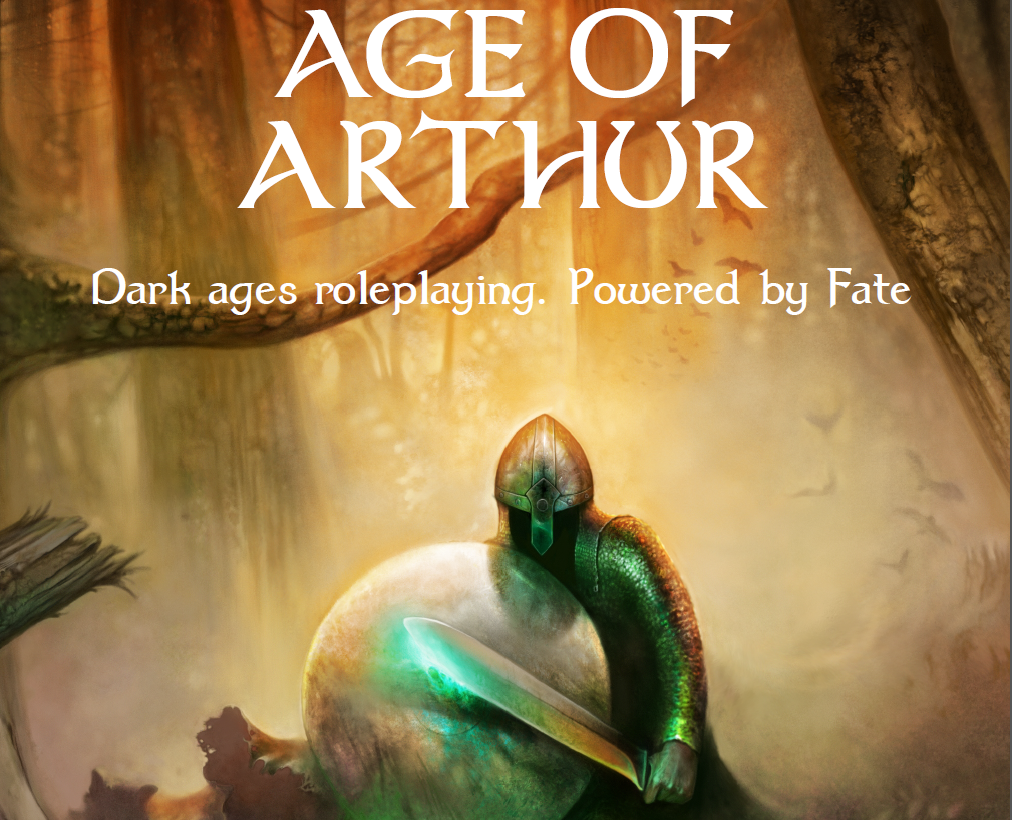
Review: Age of Arthur RPG (Fate 3.0), Pt 2

Writing: Paul Mitchener, Graham Spearing
Art: Jason Behnke
Map: Steff Worthington
Editor: Mitch Williams
Page Template: Steff Worthington
Layout: Paul Mitchener
Arthurian Timeline: Andy Sangar
Publication Date: 2013
Pages: 291 (including Index)

This is part 2 of our series reviewing Age of Arthur, and you can read Part 1 here.

***

One of the more intriguing crunchy bits in the Age of Arthur core rulebook are the rules for mass combat. Chapter 8: Battle provides a breakdown on how to run mass combat on a variety of scales, and allows for the players to have significant individual impact on the outcome. The chapter details four separate steps in running these battles, as well as a wonderfully flavorful example.

ARMIES
Each army is assigned a skill level, from 1-4, as well as a stress score based on its size. Each army has some sort of commander; who influences the army's dicerolls based on his/her Strategy And Tactics and Leadership scores. If one is higher than the army's skill the commander grants a permanent +1 bonus; if both are higher, that bonus is +2. Given the power of +1 or +2 to skill checks in FATE, this is very powerful, and really dives home the idea of an army as an extension of its leader. In addition, each army has a number of aspects assigned to it; these can be anything from a descriptor of the army itself to an aspect describing its role in the combat.

PRELIMINARIES
This section details the events that can occur leading up to the battle. The preliminaries listed are:

Manoeuvring
A successful opposed check by the commanders nets adds another aspect on the successor's army reflecting some tactical movement, such as Pinned Against The River, or Cut Off From Supply Lines.

Magic
If both armies have magic-wielding individuals on their side, they can make an opposed check to grant their armies another aspect, such as Favored By Belenus, or Posessed By Wolf Spirits. The rules do not speak to a scenario in which one magic-wielder goes against an army without one, but substituting the opposing commander with a penalty to his/her roll might suffice. The rules do, however, address having more than one magician on each side.

Champions*
This preliminary might be my favorite! It allows for an individual to call out an opponent into a Hero Duel, allowing yet another Aspect to be granted to his or her army. The rules speak to using more than one champion for Hero Duels as well. It seems to me this can also be re-skinned to allow for smaller groups of individuals to perform tactical functions separate from the main army as well. For example, we have two armies of 2000 soldiers each. The Commander of one army tasks 50 of his best rangers to sneak past the opponent's picket lines in the night and set fire to their supply tents, thus granting the aspect Hungry And Tired. You could have the heroes undergo some kind of Druidic ceremony taking them into the fae realm via dreams to influence the battle, or any number of unique scenarios with this step.

Other Factors
Here the designers address the effects of weather and fortifications; such rules could be easily customized to account for disease, local resistance, and political entanglements.

THE BATTLE
Now the carnage begins! Individual Heroics and Getting Personal both speak to using your heroes as they fight midst the throng, spending fate points and with individual skills tests, including one hero many foes. Each army then attacks, with the smaller one acting first. Successes are inflicted upon the opposing army's stress score. A draw does no damage, but allows each side to place a new aspect on the field, which can be tagged by a Commander by spending a fate point. Turns go by, and the battle ends when one side is reduced to 0 stress, which can be a slaughter, a retreat, a surrender, or any other outcome the story necessitates. In addition, there are rules for a side to withdraw or surrender before falling to 0 stress.

The Aftermath
At this point, you assess the losses for each side, and the leaders of each army can make a Leadership check to try and recover some of the army's strength. Player characters must make an check to see if they were wounded in the battle, modified by the success (or lack there of) of the army he/she fought in, and takes the appropriate damage.

Example
The last section in the chapter walks through the above steps, in an evocative combat between a horde of Angles attempting to defeat a fortified smaller Brythonic group defending a town. This example goes a long way towards showing how easy and cinematic the mass combat rules can be.

This design really seems to have a great deal of flexibility allowing for a wide range of different combat scenarios involving varied forces. Individual player characters seem to be able to have a great deal of impact on such battles, which really drives home the influence of heroes.
***

Inspired by this chapter, I designed my character for Mike's game as just such a battle commander.

Amaethon ap Aquila (converted to FATE Core)

High Concept: Devout Brythonic Veteran Battle Captain
Trouble: I've Seen One Campaign Too Many
Other: There’s Wisdom In The Old Tales
Oaths: I Pledge My Life To Protect Britannia From The Invaders

Skills:
+4 Leadership
+3 Will, Lore (Tactics)
+2 Fight, Lore (History), Lore (Languages)
+1 Lore (Games), Lore (Myth And Legend), Investigate, Athletics

Stunts:
Many Tongues: The character knows twice as many extra languages or alphabets as his level in the Languages skill would normally allow.

Planned Assault: When you make a successful Tactics check (default opposition Fair [+2]) you may add +1 to the first action in combat to all allies in visual or audible range. This ability may also be applied in Mass Combat circumstances.

Know Your Enemy: Once per session, you may automatically Create an Advantage in combat related to a weakness for the opposition.

Refresh: 3
Physical Stress: OO
Mental Stress: OOO
Consequences:
  Mild (2):
  Moderate (4):
  Severe (6):

Languages: Brythonic (free), Latin (free), Goedelic, Saxon, Greek, Pictish

Extras: Ring Mail (-1 penalty to physical non-combat skills), Shield, Gladius (Ignore one grade of armour), Cold Weather Clothing, Writing Equipment, Handaxe

Background: 
Decimus Axius Aquila was a minor government accountant of Roman lineage from Din Eidyn, the capitol of Goddodin. The book describes Gododdin as the most powerful of the northern British Kingdoms. Lying between the Walls of Antonine and Hadrian, it was never fully conquered by the Romans. For much of its history it was a Roman ally. The great Welsh leader, Cunedda Wledig was part of the royal house of Gododdin. By tradition, the kings of Gododdin spend time in each of the main settlements of the kingdom. The largest settlement, the town of Din Eidyn (which corresponds to modern Edinburgh) is where the current king, Lot ap Luwddoc, spends most of his time. The people of Gododdin are British rather than Pict, though King Lot is half Pict, through his mother, a princess of Orkney. He rules both the Kingdom of Gododdin and the Kingdom of Orkney. In order to make peace with Lot, High King Ambtosius Aurelianus arranged a marriage between Lot and his niece, Morgan Le Fay. However, under Pictish law, such things as royal rule pass through the female line and more usually through a niece than a daughter. Morgan Le Fay feels she has a good claim to be High Queen of Britain now that Ambrosius Aurelianus and her father Uther are dead and King Lot desires to be High King. The people of Gododdin and many Picts support this claim.

Decimus Axius Aquila was a student of history and lore, and had a great love of languages. His notable Roman nose earned him the epithet of Auila (Eagle). While on a trip to assess taxes in the countryside, he met a beautiful young woman named Caoilfhionn, the daughter of a druid.

After his tour was complete, he sold his holdings, bought a rural farm, and married Caoilfhionn. She was as smart as he, and steeped in the lore of Brittany. They had many children, the youngest of which they named Amaethon, after the legendary hero of myth. True to his namesake, he dreamed of being a hero himself, and come harvest-time, wielded his scythe to cut down stalks of wheat, pretending they were the enemies of legend. He took after both his father and mother- inheriting the former’s aptitude for language and the latter’s love of his native mythology.

When old enough, he became a soldier and fought in many battles. He fought for and against many ‘kings’, and earned a reputation as a formidable strategist and tactician.

While fighting for a minor lord, Owynn ap Powys, he fell in love with his daughter, Nolwenn, who bore him a single son before dying of Phthisis ten years later. Amaethon's son, Bran, then accompanied him on his campaigns and grew into a formidable warrior himself.

Amaethon fought alongside Vortigern, who hired the Germanic mercenaries Hengist and Horsa to repel the Angles. They betrayed the army, ensuring its utter defeat, and Vortigern was marked as a traitor. After this incident, Amaethon realized that in-fighting against the Britton kings was pointless, and vowed to protect the lands and culture he loved from the invaders. Now he fights against the Angles and Saxons with his trusted companion and adviser: Aedan Mordha, warrior Druid and defender of the old gods!

*This system is absolutely perfect for running the battles in the Iliad; has no one done a Homeric Cycle hack for FATE yet?

***

Wednesday, January 8, 2014

Review & Actual Play: Age of Arthur RPG (Fate 3.0), Pt 1

Writing: Paul Mitchener, Graham Spearing
Art: Jason Behnke
Map: Steff Worthington
Editor: Mitch Williams
Page Template: Steff Worthington
Layout: Paul Mitchener
Arthurian Timeline: Andy Sangar
Publication Date: 2013
Pages: 291 (including Index)

***
 
Both the most recent, and possibly the last game based on the Fate 3.0 rule-set, Age of Arthur is a bit of an oddity in the overall and ever-expanding Fate landscape. 

What makes it so odd, you may ask?

Firstly, as mentioned above, it is a game published this last year (2013) based on the Fate 3.0 system (Spirit of the Century, Diaspora, Dresden Files, Starblazer Adventures), in the same year that the newest in shiniest version, Fate Core was released to resounding success. 

Furthermore, it is from the very-small press UK-based Wordplay Games, whose only other published product to date is the eponymous game Wordplay - a dice-pool game not-so dissimilar to the Heroquest system - and a game that I happen to own, but that no one else I know has ever even heard of. 

In short:
  • It's an obscure game from an equally obscure small-press publisher 
  • It's based on a now obsolete version of the Fate RPG.
With that in mind, why should you be interested in playing Age of Arthur, a game with seemingly so much stacked against it?

The quick answer is: because of love. 

The authors clearly love the subject matter that they are writing about, and it shows in every page of this almost 300 page document. They love the legends of the Arthurian cycle, the poorly documented but evocative true history of sub-Roman Britain, and the tales of the rise of the place they call their home today: England (Englaland).

This love shows in the details shown in description of the people, places and things described in this half-forgotten and mythical world. And it shows in the care and research done to combine the Arthurian romances of the 12th and 13th centuries and beyond with the yet older Welsh traditions of King Arthur (or Artorios, per the book) and his band ; an apocryphal war-leader who fought against giants and other creatures of legend.
As you might have gleaned from my gushing above, I adore the setting for this little indie game. It's very much in my wheelhouse, having extensively researched post-Roman and pre-Norman Britain as well as the evolution of Arthurian myths myself over the past few years. 

But I think it's fair to say that even to the uninitiated the richness of the flavor and ideas found in this book should grab the imagination of even the most jaded fantasy gamer, as it goes to the source of European themed fantasy; back to the well from which the modern simulacrums draw ever upon. 

Starting this week, I plan to run a game using the world of Age of Arthur but powered by a modified version of Fate Core. As we progress, I should be posting more about the experiences of my group operating in this world, as well as some more details about the sourcebook itself.

***
Since this is a Words of Mike post, I know that you all expect to see a build. Well, who am I to let you down, then? ;-)

To start us out, here is my first build for Age of ArthurEirwen of the Summer Court:

Eirwen of the Summer Court (Fate Core)
  • Aspects
High Concept: Changeling orphan girl of the Summer & Winter Courts
Trouble: Fae mind, human heart
Other: The spirits of my ancestors call to me; Rhoald is ever at my side
Oaths: Y Ddraig Goch shall pay for what he did to my kin!
  • Skills
+4 Lore (Divination)
+3 Athletics, Lore (Fae Magic)
+2 Notice, Rapport, Will
+1 Empathy, Deceive, Fight, Stealth
  • Stunts
Beauty of Annwn: You can sub Fae Magic for Rapport when attempting to charm or seduce. As this is achieved via a magic talent, it can be resisted by skills that defend against magic.
Spirits of the Dead: Once per scene, you may call upon the spirits of your ancestors for aid. Spirits summoned in this fashion have skill points equal to your Divination. Summoning a spirit costs an action, and you must give up an action to give a spirit a command.
Forestwalk : The spirits of the forest ever guide you. Sub Fae Magic for Lore (Wilderness) to Overcome travel challenges whilst in a forest environment.
  • Refresh: 3
  • Physical Stress: OO
  • Mental Stress: OOO
Consequences:
  • Mild (2):
  • Moderate (4):
  • Severe (6):

Languages: Fae, Brythonic

Extras:
  • Fae-made dagger: Cost 1, Light, Can be thrown
  • Gladius: Cost 2, Standard, Ignore one grade of armour
  • Embroidered Robe: Cost 2
  • Basic Survival Equipment: Cost 1, Knife, cloak and means to make fire
***
Rhoald the Barghest (Major NPC)

  • Aspects
High Concept: Barghest of Unseelie Court
Trouble: Mortal flesh is so very, very tasty...
Other: Eirwen is the loveliest of all
  • Skills
+3 Fight
+2 Physique, Stealth
+1
Athletics, Notice, Lore (Fae Magics)
  • Stunts
Creature of Shadow: You gain +2 to Defend against detection when in darkness or shadow.
Ambush Predator: Gain +2 to Attack with Fight when you invoke an aspect representing the element of surprise.
Unnatural Vitality: You are treated as wearing Standard armor for damage-absorption purposes.
  • Physical Stress: OOO
  • Mental Stress: OO
Consequences:
  • Mild (2):
  • Moderate (4):
  • Severe (6):
Background


Eirwen is a child of of Britons, the inhabitants of the isle since ancient of days.

For generations her people lived under the threat and overlordship of the Great Red Dragon Y Ddraig Goch; a creature that demanded tribute in the form of virgin (human) flesh and treasure, until the Christian priest Padrig taught them that such sacrifices were wrong, to to trust in the protection of the God of the Cross.

But this new god proved impotent against the wroth of the dragon’s ire, and Eirwen’s people were destroyed, every man, woman and child; save young Eirwen, who fled for her life into the ancient forest that bordered her people’s home.

Taken in by the Seelie Court of Queen Titania, young Eirwen learned much of the magics of the Summer Fae, before being traded to the Winter Court of Queen Mab; who had taken a fancy to the bitter and scarred young girl.

Freed from the service of both courts due to the resolution of the treaty, Eirwen is now able to pursue her own destiny.

With her erstwhile companion Rhoald the Barghest at her side, she now searches for allies to achieve her greatest goal: to find the Great Red Dragon himself, and destroy him...no matter what the cost.

***

Thursday, January 2, 2014

Character Highlight: Balsa, Spear-Fighter of Kanbal (Fate 2.0)

Ah, January.

Named after the Roman god Janus, the god of beginnings and transitions. Depicted as having two faces, since he looks to the future and to the past.

In his honor then, as we now all look forward to the new year of 2014 I am taking this opportunity to look back into the past as well: to the first published version of Fate (then called FATE 2e) back in year 2003.

This was the first version of Fate that I read, and the first that I attempted to hack. Even back then, the system was very much designed to be hacked, with multiple possible rules variants and advice for keeping things light and moving forward. For example, when discussing setting difficulties as the GM (sidebar, pg. 15):
"When all is said and done, setting difficulties is more art than science. While it is possible to provide guidelines for what reasonable difficulties might be, the GM will eventually find herself in a situation where she is going to have nothing to go on but her best guess.  
The urge in those situations is often to take several minutes to dig through the rules, looking for some explicit ruling - RESIST THAT TEMPTATION! We'’ve written the book, and we can assure you that rule is not in here, so trust yourself, and use your best guess."
 This reads rather refreshingly like a piece of advice that might appear in Fate Core ten years on. So although the particulars might change, the Core of Fate - being the philosophy that guides it- remains the same.

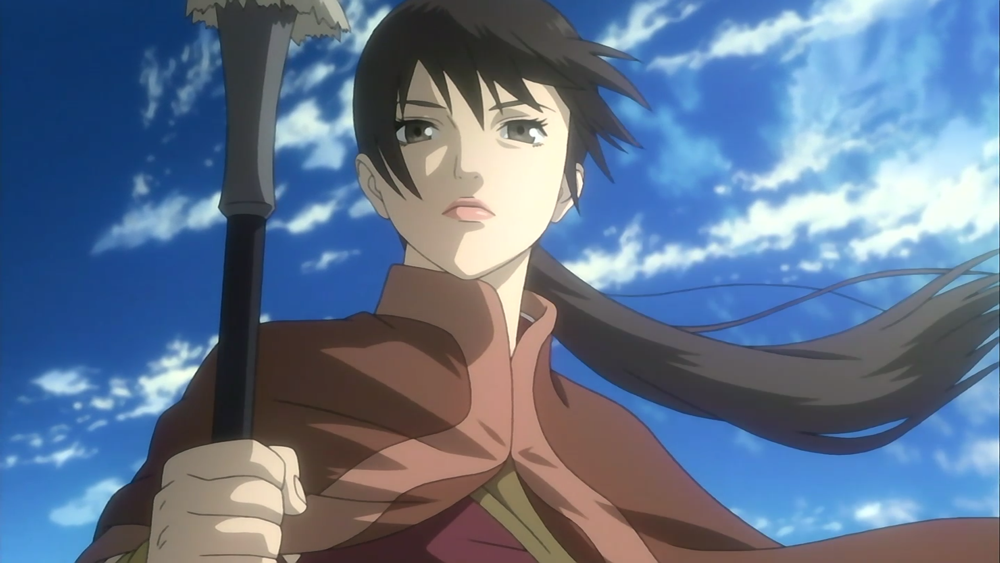
Looking through my old builds for Fate 2.0 today, I found one for the character Balsa from the anime Moribito, Guardian of the Spirit:

http://moribito.wikia.com/wiki/Anime

I won't post that build here: I am sure that the readers of the blog have certain standards, and my early builds were rather poor. But in the spirit of looking back as well as looking forward, here she is built using FATE 2.0 rules fresh for 2014:

Balsa, Spear-Fighter of Kanbal (Fate 2.0)
Aspects
  • Bodyguard for hire: O
  • Jiguro trained me..reluctantly: O
  • I’ve vowed to redeem eight souls: OO
  • I know people everywhere: O
Skills
+3 Melee
+2 Athletics, Unarmed
+1 Awareness, Endurance, Impress
+0 Deceive, Languages, Lore, Riding

Fate Points: 3
Goal: "I will protect my charge."
Outcomes:

  • Scratched (0):
  • Clipped (1): OO
  • Hurt (4): OO
  • Injured (6): OO
  • Taken Out (7):
Background

A skilled warrior from the faraway land of Kanbal. She is 30 years old.

Balsa is pragmatic and intelligent and she does not hold much regard for class distinction customs. Despite her deadly skill with a spear, Balsa tries not to kill in combat. As a result her body is covered with scars.

She is the daughter of the former Kanbal King's physician who had discovered that the new King had poisoned his predecessor. Worried that his crime would be revealed the new King ordered the physician and his daughter, Balsa, be executed for treason.

To protect his daughter the physician asked the one warrior he could trust, Jiguro who was the first of the King's 9 Spears, to take her and run while he stayed behind. Unfortunately the King sent the other 8 Spears (while holding their families hostage) after them. Her guardian was able to protect her but had to kill all 8 of his former comrades to do so.

Later he taught Balsa how to use a spear responsibly after seeing her perfectly re-enact the moves she'd seen him use.

Although Balsa claims to be a simple bodyguard-for-hire; in reality she wields her spear in order to save lives in atonement for the eight lives that were taken to protect her when she was a child. 

***
FATE 2e PDF

*Edit 01/03/13 - Updated with character Goal, since I forgot it in my original build.

Tuesday, November 19, 2013

Actual Play Report + Review: Dungeon World - 1st Session and Impressions pt3


Logo from the beautiful Italian version of the game!
Continuing where we left off from my first and second posts, here are my continued thoughts and AP from my group's first session playing Dungeon World.
***
The small crevice opened up by the dwarvish miners was just wide enough for a single body to pass through at once: and even this made for a tight squeeze.

As self-appointed protector of the party Naeriel was tempted to go in first, but when she peered out into the darkness without she saw nothing; only her hearing gave her any impression of the contents of this new area, filled with the sounds of the clanking and clamor of iron against stone.

Backing out, she allowed the dark-elf Briza to take a glance instead, as her eyes were able to see as if day in the pitch-black gloom.
Apparently Dungeon World elves don't get infravision...bummer.
Moving stealthily through the opening, Briza pokes her head out and peers within:

Her gaze rapidly adjusting to the nigh-absent light of the room, she views a vast columned chamber which could only be described as being carved out of the earth; almost like a natural cave but clearly worked by human or human-like tools, with evidence of the work of picks and shovels throughout.


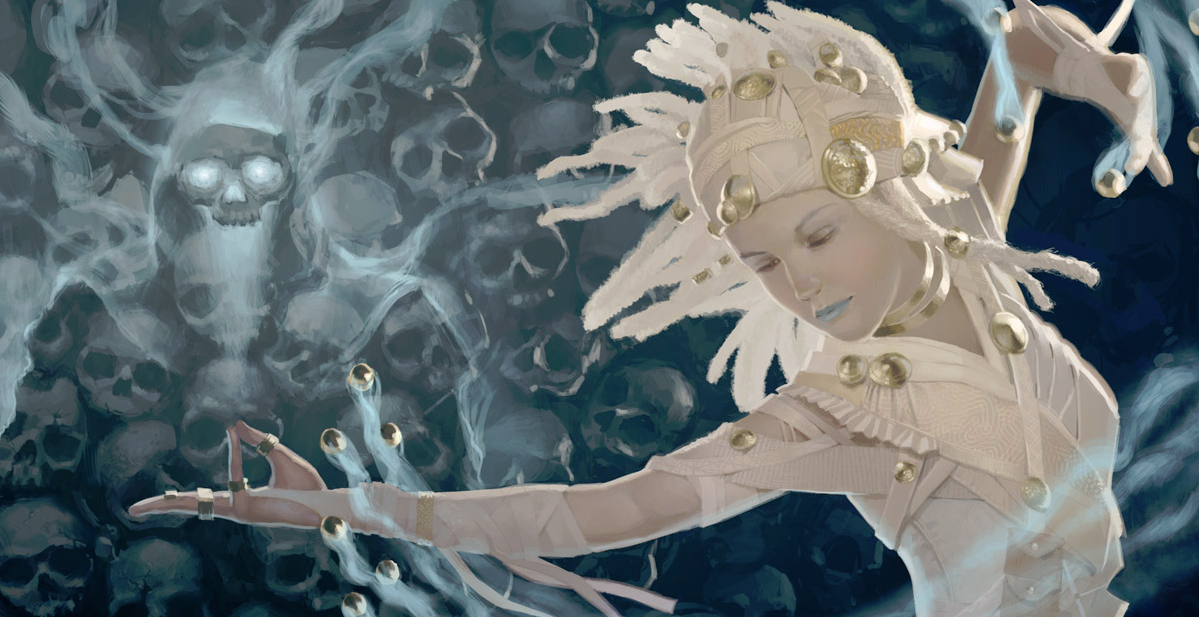
The apparent origin of all of this industry was in plain view as well. Lining the walls and working with picks and shovels were strange man-sized figures, covered only in bandage-like wrappings that covered their thin and emaciated bodies.

Disturbingly, their eyes were covered in the same wrappings, which like the rest of their filthy grave-clothes-like raiment was covered in mysterious sigils. Only their mouths were completely free of the wrapping, and these revealed agape and drooling jaws (complete with lolling tongues) to a one.

Turning away from this disgusting sight, she peered down further into the vast hall where she could just make out the faint flickering of torches, as well as the sound of guttural voices punctuated by the cracking of a whip. Apparently the 'workers' had overseers, and by the regularity of the sound of the whips, cruel ones.

Not risking being seen (although it wasn't certain that the mummy-like figures could 'see' at all), Briza lithely moves back through the entryway to report what she had seen to the party.

When questioned whether or not the workers she saw were truly alive or undead (a serious point of interest to Naeriel, who needed to know exactly who she might be fighting), Briza had to say that she did not know.

What she did know for certain was that the cruel overseers she heard were definitely goblins: although she did not speak their tongue, she knew the sound of it well. And goblins are the exact sort of minion that a lich-lord might hire as well.
At this point we started discussing marching order, D20/OSR style. Naeriel wanted to go first, since she was by party role the tank: but the thief Jagelio was by far the best at sneaking about, so it was decided to let him explore before everyone else popped in. Naeriel's bond demanded that she look after him though, so order was decided at Jagelio, then Naeriel, then Briza, followed up by Emen.
Jagelio took to the shadows; disappearing completely from view like he was a shadow himself. Following behind, Naeriel cautiously traveled from pillar to pillar, moving towards the dim light and sounds produced by the cruel goblin overseers.

Soon she became separated from the group - in the dim to absent light it was hard to gauge relative position, and she had no idea where Jagelio had gone to (as usual for the thief). Swiveling around a last pillar, she found herself face to face with one of the goblin overseers!
At this juncture I started rolling a lot of 6 and under results....hilarity ensues!  
For a brief instant, the goblin simply stared agape at this new interloper, too shocked to take action. Then, suddenly it opened it's overly toothy mouth and began to scream! As if called to action by this sound, slowly but with determination the workers stopped their toil around the hall and began to shamble in close upon the elf.

Naeriel was seized by an uncharacteristic uncertainty: if these creatures are alive and somehow ensorceled to serve these cruel masters, it would be wrong to do violence to them. Holding her sword up in a defense stance, she freezes in hesitation as the shambling workers close ranks on her.

But the cruel goblin had no hesitation at all; still screaming loudly, it raises up the whip in it's hand (the whip itself appearing to be crafted from bones), bring it down hard up on Naeriel. She is able to block the brunt of the attack with her sword, but the tendril still reaches around to strike her arm: rending her elvish woven armor and drawing blood.

Cringing from both the pain as well as the embarrassment of being caught off-guard, Naeriel quickly counter-attacks the horrid goblin with her two-handed blade. But between the pain of her new wound and the now crushing presence of the still closing ensorceled workers she loses her balance..and the sword flies free from her hands, clattering onto the cold stone floor.
Nasty little gits, really. 

At this moment, Briza has finally made her way to see the commotion caused by Naeriel's discovery. Without hesitation she channels the powers of her attuned element, causing a dagger of purest ice to fly from the focal point in her forehead and impaling the shoulder of goblin that had assaulted Naeriel but a moment before, causing it to drop it's whip.
The goblin looks now towards Briza with a mix of shock and anger, lurching towards her...only to be stopped when a hurled dagger flies out of the darkness and into it's forehead. Almost comically, the creature stops for the briefest moment before dropping dead where it stands. Jagelio's handiwork.
Meanwhile, Naeriel is scrambling to pick up her sword. From the darkness, she sees a second goblin began to run towards it as well. The race is on!
Moving lithely through the grasping hands of the workers she comes to almost...almost just!..grasp it, before being caught finally in the grip of the circling mindless mob. Once in their clutches, they began to mercilessly tear and rend at her flesh with their sharp, unclean nails, dragging her away from her prize and salvation.
A note here about Dungeon World's initiative system: there isn't one. During all of the action outlined here rather than taking turns we took 'screen time' where the players took action. The GM Gary balanced this well, giving the action a highly cinematic quality. Very cool.
Seeing that his comrade was in trouble, Emen finally joins in the fray. Calling upon the dark powers at his disposal, he curses the goblin reaching for the sword, making one of it's healthy legs now lame. The goblin trips and falls before it is able to grab onto Naeriel's ornate elvish blade.


But the exercise of these dark forces comes at a high price: suddenly the nearest shambling workers turn their shrouded faces towards the necromancer in unison, and began lurching towards him with clearly violent intent!
At the same time, Naeriel finally breaks free of the vicious grasp of the workers, the somersaults forward and swiftly takes back up her sword.
Rising to her feet in single fluid motion, she points the blade at the goblin who had been lunging at it but a moment before and asks rhetorically:
"You wanted this?"
..before stabbing the creature with it through the heart. The creature dies instantly. A clean, quick death: Naeriel's forte.
As the workers close in on Emen, the necromancer quickly works to animate the nearby corpse of the goblin recently felled by Briza and Jag. Daggers fly out of the darkness - Jagelio again- but their numbers are too many and quickly Emen is encircled by the shambling workers...
As she pulls her sword from the fresh corpse of the goblin, Naeriel realizes, that she is also surrounded by a closing circle of shambling workers. Already covered in wounds and still uncertain whether it is right to slay them, she steels herself for the very worst...
Briza is torn...the necromancer is surrounded, but so is the party fighter. She knows she must take action, but she hears Emen say:
"Uh...undead shamblers. I'm working on it..."
And with that decides to aid Naeriel. Summoning the power of cold again using her focal point, she covers the ground in a thick sheen of black ice, sparing only the 5ft circle where Naeriel stands. The shambling workers (revealed as undead per the necromancer, who should know) slip and fall over one another in unison.
Calling again upon the black forces that power his craft, Emen reanimates the corpse of the goblin taskmaster as his thrall. With a flurry of action the creature is able to buy Emen some space with the biting of teeth and the slashing of claws before disintegrating: having worked so quickly, the animation magic made the vessel unstable. Once again the shambling zombies begin to close in...
Naeriel's elvish eyes might still struggle with the gloom, but her long elvish ears work just fine here: she heard the necromancer state that these enemies were undead..and therefore fair game!
Taking up her 'Circle of Death' stance, Naeriel makes sure that she has a firm grip on her sword, then makes a single deadly whirlwind strike upon the surrounding zombies, still tripped up or stilled upon the ice.
The carnage is gruesome: everywhere lifeless limbs and heads are hewn asunder, black ichor spraying carelessly onto the icy dungeon floor. When she arises from the single long strike like a dancer exiting a pirouette, the entire mob of them lies before her, mangled and defeated.
The necromancer, however, is in no position to view this exercise in martial prowess, as he is now surrounded by his own mob of attacking zombies. Together they claw and rake at his flesh, while Jagelio fires daggers from some hidden spot in the shadows, and Briza summons her element again to come to his aid...

Seeing that the battle is not yet won, Naeriel jumps onto the ice, using it to skate over to where the mobbed necromancer stands. She arrives and her blade strikes true: and together the trio manage to slay the last of the zombie workers.
Meanwhile, the last goblin overseer, seeing as he is horribly outnumbered decides to make a run for it. But he doesn't get far before two swift daggers (Jagelio again) pierce him in the leg and head, ending both his escape and his life.
With the last of their opponents still, the party takes a moment to reflect and take inventory. Both Naeriel and Emen are worse for wear: especially Naeriel, who is now covered in red weeping gashes where her beautiful elvish armor has been torn.
And this is but the first room: what other terrors might the lich's tower hold within?

Continued in part 4!