Showing posts with label D&D. Show all posts

Wednesday, July 2, 2014

I Kissed a Pathfinder..and I Liked It (Pathfinder)


If you have been following this blog - and if you have, thank you! - you will be no stranger to my personal ambivalence towards d20 based games.

Why ambivalent? Well, like most of my generation, I started in this hobby by playing D&D; the original d20 game, back before d20 became a thing-unto-itself. So for me, d20 is the baseline by which all other games evolved outwards from. I can't really hate d20; d20 is my roots, after all. And within it are the basic building blocks for the hobby itself.

But...I've moved on, right? I have other, more advanced - more modern - game systems to play. Fate! Dungeon World! If I want a crunchy d20 game to play, I can spy Fantasy Craft right there on my shelf, waiting to be explored.

Plus, I've played a D&D 3.5 game, and I found the whole experience utterly lamentable. The basic problem was we had GM who was utterly committed to playing the game RAW with no exceptions: but really, if any game played RAW is a dull game, then it's just a bad game system. Right?

Right.

But...well, then there's Pathfinder. The sexier younger sister to D&D 3.5, with the beautiful art and presentation, with the legendarily well-written and flavorful modules ('Adventure Paths'), play-tested and fan-supported, all wrapped up in a cute little bow by local Seattle-area gaming studio Paizo.

Pathfinder always intrigued me. But not enough to play the damned thing. I flipped through the main book, and the modules, and the innumerable splat books with interest and appreciation..and then put them back on the shelf of my FLGS. Great stuff guys...but no thanks.

Flashback to 2012: looking for some gaming aids for my ongoing Fantasy Craft campaign, I stumbled across the Pathfinder Beginner Box. Complete with a playmat, some artful 'pawns' (cardboard miniatures), and set of dice, for just under $30.00? Sure..why not!?


And my gaming group used the hell out these tools: the dice rounded out my polyhedral collection well, and the map and pawns got plenty of use in our Fantasy Craft campaign. As for the rest - the character sheets and pregens, the Game Master Guide and Heroes Handbook- these stayed in the box as curiosity. Flipped through, but unread and unused.

Flash-forward to 2014. It's 8am on Saturday morning, and I'm packing up my stuff for Go-Play NW 2014. Gary has a supers game set for the day...but I've got nothing at all prepped to run. My eye spies the Pathfinder Beginner Box, and I think: sure, why not? If we have a spare moment during the day, I can run this. Easy-peasy.

Long story short: such a spare moment appeared, and I wound up running a game using the Black Fang's Dungeon scenario from the book. The result? I loved running it, and my group had a great time enjoying an old-school dungeon-crawl.

Before we go any further, note that I made some minor rules modifications before we even got started:

  • I failed to bring the playmat and minis, so movement and range were made to be largely narrative: Close (melee range), Near (penalty-free ranged attacks) and Far (ranged attacks at -2). Characters were allowed to move one 'zone' for free, or two by giving up an action.
  • Skill use was based on narrative justification: if you could justify the use of the skill, it was valid. If the book said 'Knowledge: Religion' was needed for the check, then 'Knowledge: Arcana' could sub as well.
  • Penalties for firing into melee combat? Attacks of opportunity? All narrative: the GM says when this stuff matters. If it slows things down or makes the experience suck..it doesn't matter.
  • You had to narrate what you were doing to do it. Attacking a goblin? Tell me how you are doing it! You succeed and kill a goblin? Narrate that shit: I want some cinematic flavor at my table, or it's all just boring numbers.

In short, I was running the game using Pathfinder mechanics to modify rolls, but acting like I was GM'ing a game of Dungeon World. And it worked like a dream, and fun was had by all.

What's the take-away from this experience?

For me, it's that any game system can be fun, provided that everyone - players and GM included - are committed to having fun. The minute that any rule gets in the way of that, that rule should immediately be abolished or ignored. 

Secondarily - but just as important - don't ever think of the players as agents that derail your story. They are there to contribute to the story. The players will do things not imagined by you or the module's designers: in this case, improvise!  

In the case of this module the scenario suggested either a resolution as a physical conflict or a diplomatic one: in reality, it was both with the players slaying King Fatmouth and interrogating a charmed goblin;  I chose as GM to provide the 'diplomatic solution' info via the charmed goblin, as this seemed the logical reward to this cautious approach. The story was thus adjusted based on player initiative, rather than being derailed altogether. 

So will I be running more Pathfinder games in the future? 

Sadly, the answer to this seems to be 'no'. My gaming group prefers the flavor found in newer - and more narrative, and flexible - game systems like Fate: as soon as I suggested we play Pathfinder ongoing the conversation led to talk of Fate Freeport being used for fantasy gaming. Which is great: I loves me some Fate gaming.

So for now, Pathfinder will have to live in inside of it's little Beginners Box, unloved and hardly played. But we did have a moment, once.

And I liked it. 

***

Tuesday, January 21, 2014

Game Theory: What's on the menu?

Say what you like, Pathfinder's got Class

It's 1985, and my friend Brian (a huge fan of the newly published Dragonlance novel, Dragons of Autumn Twilight) convinces me to purchase the D&D Red Box at the local Toys "R" Us so we can play a game with a similar cast of characters that he had come to love in that series.

Getting back to his house with our newly obtained loot, we open up the box and start reading (after marveling after the odd dice and little crayon included, along with the map). 

We start with the one marked Player's Manual, as it is inscribed with bold yellow letters saying: READ THIS BOOK FIRST! The color, the fact that it's in all caps and with the added '!' indicates that this is an important prerogative, so we dutifully comply. 
Immediately we find that the book gives us a series of options to play characters; this is not some free-form improv-theater piece where you just make up a guy and bluff your way through. It's hard-coded with options that reinforce what sort of characters are expected to appear as protagonists are expected to appear in this world. These options were:

Humans (Yay! We are human, and we get to pretend that we are other humans!)

  • Cleric
  • Fighter
  • Magic-user
  • Thief
Demi-humans (Yay! We are human, and we get to play things that are almost, but not-quite human!)

  • Dwarf
  • Elf
  • Halfling
Now, I had bought this game to play a Magic-user - since magic is cool - so I knew immediately what 'Class' of character I wanted to play already (although I looked REALLY hard at the Elf as a option. He gets to do magic AND he's good at fighting? Money.)

So I rolled up my character as per the book, didn't get a high Intelligence (which the book said I HAD to have to even play a Magic-user), so Brian and I agreed that it would be OK to switch some numbers around to facilitate that. 

Time from reading my first RPG to hacking my first RPG? About 1 hour.

From there I picked out a few weak first-level spells, choose some languages I knew, a bought some gear with what little money I had from the gear list, and went into my first dungeon (and somehow survived it, which is a wonder to this day).

Looking at the most recent version of D&D today, although a lot has changed (Elves and Dwarves and Halflings are still there, for example, but they are no longer 'Classes') the fact remains that the system is still very much menu-driven: rather than being given limitless options to make the character you envision, instead you are given a 'menu' of options to choose from, and build around that. 

You choose:
  • Your Race
  • Your Ability Scores
  • Your Class
  • Your Skills, Feats, Powers, and Equipment (as appropriate for your Class)
  • Your Alignment
Once this is resolved, voila! You are ready to do some D&D. 
Make sure to fill in all the circles, please.
As per the original D&D, the 'menu' concept continues from there as you play; as you gain Experience Points (the meta-resource for the game that enables you to gain new abilities), you are given new options to build upon your abilities. But as offered in character creation, the decision-tree presented for advancement is determined by the original choices you made for your character when you started. The choices you make simply offer new sub-menus with limited numbers of new options you can add to your character.

Every RPG system to date has some form of menu available to choose what sort of character you are playing, and what they can do well or not-so-well. Some of the lists can be bigger and offer more choices than others (GURPS, for example, has a mind-boggling number of options right out of the box), and some smaller (indie-darling Dungeon World has a relatively small menu to choose from vs 4e), but there is still a menu regardless.

Why is this? Why do we want or need a menu at all? Why can't we just say: 'Here's my character, this is what motivates him, and this what he is good and bad at', and hit the gaming table with that?

Well, menus do a few key things for RPG's:
  • Menus reinforce genre. Having a game where the options include Cleric, Wizard and Fighter but does not include something like 'Cyborg' tells us a lot about the world the characters are expected to appear in.
  • They also help define Party Roles, which is important for team-based play; a state assumed by 99% of the RPG's on the market.
  • Menus (in theory..) promote game-balance. By clearly defining what sort of abilities can appear on the table in any combination, you can limit Mary Sue-ism and reinforce party roles, as above.
  • Having a menu also helps players to decide what sort of character they will play by defining what sort of character is allowed in the game. If you have no clear idea of what sort character you want or what traits they should have, having a limited list to choose from is of help.
But it's not all gravy. Menus also limit you in some key ways as well:
  • They limit your options. Want to play a Fomorian princess-in-exile who can cross between the Otherworld and our own? Too bad; that's not in the book. 
  • They limit imagination. You want your wizard to cast a huge spell that impresses the frost giants into aiding your cause? Too bad; you have nothing that allows that on your character sheet. Think of something else.
  • They can also create the bizarre netherworld of 'Character Optimization'; a term that comes up often in reference to D&D 4e and her prettier and more popular sister, Pathfinder. Just because you have more than one option to choose from when creating and advancing your character doesn't mean that they are all equally useful. Which segueways us well to the next issue...
  • Menus promote samey-ness. If my optimized fighter with optimized gear looks just like your optimized fighter with optimized gear at Gen-Con, it's like two girls in the same dress at the prom. Neither one of us looks very unique or interesting next to the other. 
My current interest in more 'rules-light' systems like Fate or Heroquest is not because I hate all-the-damned-rules; I've happily played and run games with all-the-damned-rules just fine, thank you very much.

The main appeal for me is that these sort of systems allow me to play what my imagination summons up without having to either hack the system, make my own playbook from scratch, or ignore some rule to make it work. In other words; I have the freedom to order something not on a menu.
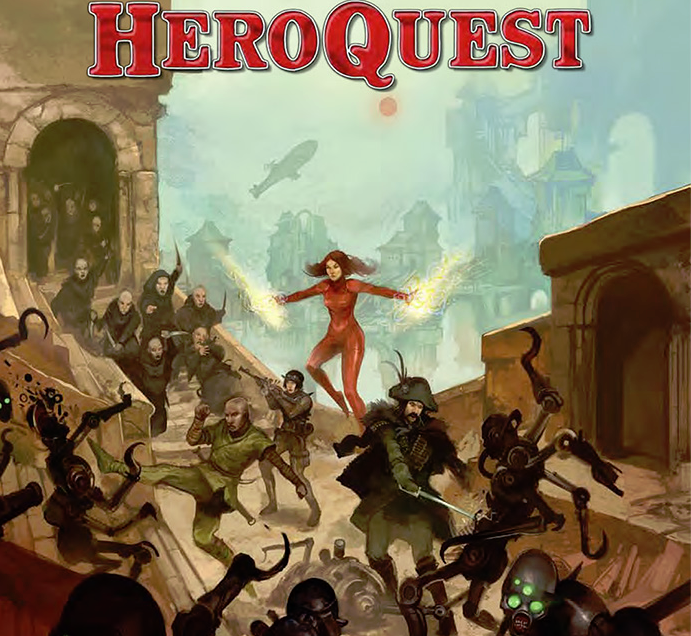
Dagger-wielding cultists, evil robots, and a zeppelin? Huh, guess it's Wednesday already.
As a GM, I have always had the freedom to make my NPC's as I like with just about any RPG on offer. But as a player I want to have that same freedom when making and advancing my character, and as GM I would like my players to have that same freedom as well.

Note that this sort of freedom is not by necessity limited to 'rules light' systems either; Mutants & Masterminds grants a massive number of options for character creation, and allows the player to pre-flavor them as desired, as does the ever-popular Savage Worlds (although Savage Worlds could be described more as 'rule-medium' at worst).

It's no secret that my current RPG drug-of-choice is Fate. I've been tinkering with it since I first discovered it as FUDGE-hack, and for the same reasons noted above; because it allows me to make the character I want to play at the gaming table straight-out, and not some compromise that some distant game-designer thought I might like to play; nor do I have to wait until I've reached some arbitrary 'level' to play them.

In Fate, for example, if I want to play a wizard with Hands burned by the cold fire of the underworld, who has Shadow-demons that respond to my whispered commands, I can. No hacking required; just add those Aspects, some Skills or approaches to reinforce this, and maybe some Stunts and/or an Extra to back it up, and 'boom!': I'm ready to do some Fate.

For me, this is all-kinds of awesome. I'm now given permission to play what I want at the gaming table, and my friends are as well. 

As noted above, however, there is a trade-off here; by abandoning a menu-based system we have opened the possibility for confusion. With no road-map, with no clear path to create characters, we are now largely left our understanding of the system to create characters; and this is often a scary path for new players and even new game-masters.

In many ways this is the main failure of Fate Core in particular; by not providing a good number of examples for creation of characters (something I think Savage Worlds and Mutants & Masterminds in particular does well), new players are largely left adrift at sea when making sense of what the system can do. That's unfortunate, and I hope that some of my posts here might assist in that regard.

That being said; despite the difficulties involved, for me the effort is worth it to make the characters we want to play appear at the gaming table.

It may be the chef's (game-designers) pots, pans and range we are using, but we get to pick the ingredients now. And we have free-run of the kitchen:

So let's get cooking.

***

Friday, November 15, 2013

Character Highlight: PunPun (FAE)

Back when D&D 3.5 was still young, WOTC had a thriving message board community. Of note was the Character Optimization forums, a wonderland of ingenuity! Originally conceived of as a place for you to work out your character concept, it was quickly overrun by optimizers, and WOTC was forced to split the forum into Character Development (fluff) and Character Optimization (crunch).

Strange and wondrous things could be found in this place, where math majors went to work using spreadsheets calculate your Power Attack bonus and how to best make some Chosen of Mystra with 10 actions per round and a sweet Figurine Of Wondrous Power: Obsidian Camaro. In this seething cauldron of nerd-heroin, no published rule was safe; no splatbook neglected! For years, the Cleric and Druid fought for the title of Most Likely To Give Your DM Hives.

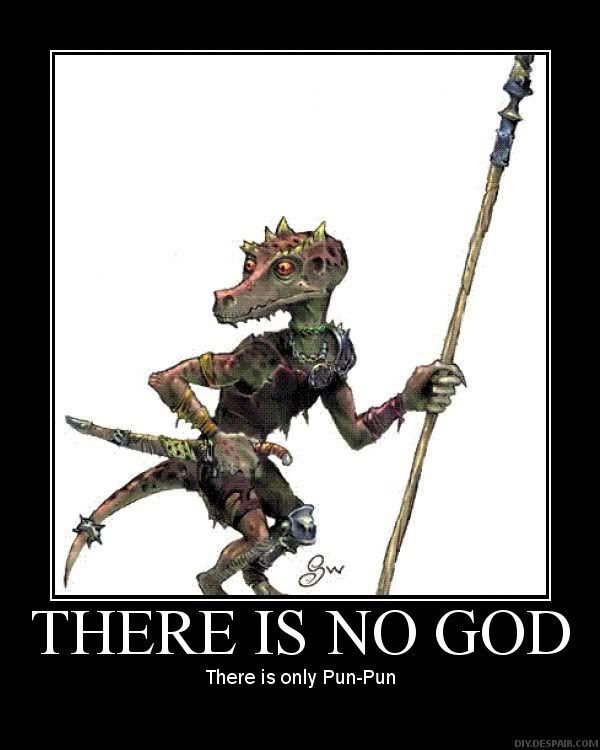
Sometime thereafter, around 2005, a thread was created called 'Incentive to Play a Kobold.' A poster named Khan_The_Destroyer came up with a build that would forever change the universe. Hither came PunPun, green-skinned, fiery-eyed, viper familiar in hand, a wizard, a reaver, a slayer, with gigantic melancholies and gigantic mirth, to ravage the patience of every GM under his omnipotent feet!

PunPun 1

Aspects
PROTIP: Don't Google image search PunPun at work.
High ConceptKobold Divine Minion 1/Wizard 1/Master of Many Forms 3
TroubleI Will Make Your GM Hate You
OtherImmune To All The Things, You Can Shove Your GM Fiat

Approaches
+30 Clever
+30 Forceful, Careful
+30 Flashy, Quick
+30 Sneaky

Stunts
  • Because I can Manipulate Forms At Will, I gain a +20 to Forcefully Overcome or Attack when I change shape.
  • Because I Legally Exploit All The Books, I can change my Aspects, Approaches and Stunts At Will.
Refresh
Stress
Consequences
  • Exasperated Sigh (2):
  • Goddammit, NO! (4):
  • Kicked From The Group (6)
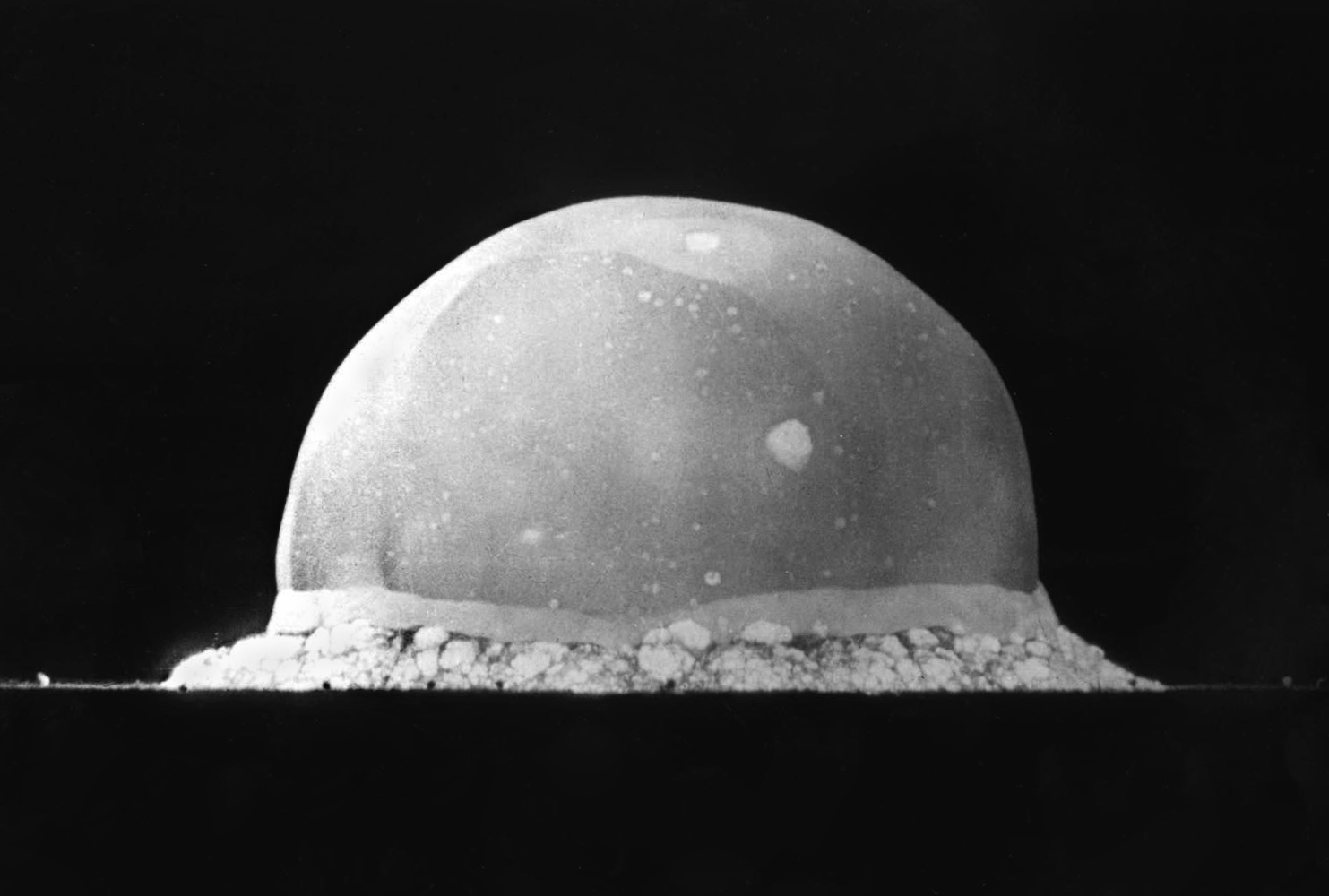
You can read the original PunPun post here. Of course the community, being as it is, could not just let PunPun be; many tried, and all failed to defeat him. The best part would be the multitude of posters chiming to express their dismay at trying to convince their DM to let them play PunPun, despite the original poster expressly stating that he is a thought experiment and never meant to be actually played. This is a good thing, as allowing him in your game is directly analogous to Robert Oppenheimer's dismay at witnessing the Trinity test!

This is the only known photograph of PunPun in play.
1Note - while Pun Pun may be legal in D&D 3.5, he's certainly not in FAE; here he functions as a conversion.

Tuesday, November 5, 2013

D&D Classes as Extras in Fate Core

My group's dabbled in D&D, but it's never really stuck. As a player, it's fine, but it's a lot of work for the GM. We tried converting to Mutants and Masterminds, which was about as far as you can get from "reduce GM workload". Then we restarted a new campaign in Savage Worlds, which is going well so far. The GM and I were talking about possibly using Fate, however, and I thought it'd be worth posting about.

D&D is a game where you play a Class that does Stuff and Thangs different from other Classes. You're the best at using your Thangs, and you get more Stuff when you Level Up. For me, that mechanical leveling and niche protection is a large part of what D&D is.

My goal here is to get a sense of "leveling up" back into Fate without having skills and stunts reach ridiculous levels. At the same time, I want to see if I can get a stronger distinction between classes. So:

Class Abilities

Your Class can and should be represented by one or more aspects, but beyond that your Class is an Extra. It works like a skill pyramid made up of Class Abilities, which are stunt-like shifts of effect. At level 1, you get a single shift of effect, named appropriately for your class. A Fighter might have "Power Attack +1" or a Wizard might have "Magic Missile +1". At level 2, you gain another +1 ability. At level 3, you can either have three individual +1 abilities or one +1 and one +2. A +2 ability costs 2 XP (or whatever we end up calling the resources used to increase these things), a +3 ability costs 3 XP, and so on. The abilities also need to follow a column or pyramid structure, so you can't just have a single +2 ability at level 2; you'd need to "support" that +2 with a +1 underneath it.

6th level Rogue example:
Sneak Attack +2 [ ]; Disarm Traps +2 [ ]
Sneak Attack +1 [ ]; Evasion +1 [ ]

What are the brackets [ ] for? Well, I'm ripping off 2nd edition Fate with some of +Mike Olson's Thrilling Fate hacks. You can use each class ability once, gaining the listed bonus on a roll, and then that ability is exhausted until... I don't know yet. Maybe an "extended rest", but I never liked the weird resting dynamic in D&D myself. Maybe anytime there's significant downtime (your extended rest goes here), you clear all your abilities. Otherwise, you can clear one ability per scene? Refreshing these abilities also seems like a space where you could have other class abilities interact. Maybe the Cleric can refresh his allies' ability pyramids. Maybe monsters have these abilities as well. This skews kind of close to 4e's encounter powers, especially when viewed from the monsters' PoV.


Are class abilities aspects? Maybe? I think they need to have some of the "fictional truth" that aspects have: a Magic Missile can strike at range, a Sneak Attack can't be done if the bad guy knows you're there, and so on.

Are these abilities only bonuses? I don't think so, I think you can use the stunt guidelines. For example, typically I see "hit everyone in a zone" as a 2-shift cost, so you'd need to be a 3rd level Wizard before you can get a +2 class ability. At that point, you could take Fireball. It wouldn't give a +2 to your roll, but you could strike everyone in a zone.

It's a half-baked idea, and there are tons of ways to do D&D murderhobos in Fate, from using the game as written (such as in the Core book example characters) to combining FAE approaches and D&D classes. This way is just how I'd start doing it.


Thursday, October 17, 2013

Plug And Play: Maps For The Lazy

I used to spend so much time as a kid with my graph paper and pencil, crafting elaborate dungeons for my players to explore. Even when I was not running a game, I was at it, drawing in secret doors, statues, pit traps and the like. Half the fun was painting yourself into a corner and trying to, to use a writing analogy, let the character figure his way out. Why is does the dungeon transition from being carved out into a natural cave feature? How could you use the underground river to get around the bugbear lair? Why didn't Gygax make a map icon for the toilet?

I tended to put curtains all over my dungeons. No idea why.
Creating this environment for pcs to explore was always at least as much fun as actually letting them explore it.

As many of you probably agree, creating gaming maps is, to a large degree, a kind of art-form; there's a reason Christopher West gets paid to do it and not me!

Now that I'm older, not only do I not have the time to play as many games as I'd like, but the prep time available to me to prepare for my own game is limited as well. This annoying logistical complication is undoubtedly one of the reasons why the lot of us here at Station53 espouse such a player-driven narrative, since it has the bonus effect of eliminating much of that much of that preparation. That being said, even with an pseudo-abstract, non-tactical system such as Edge of the Empire, I still need maps to keep everything straight in my brain. Fortunately, the Gods have provided us with the internet.

Google Image Search is a powerhouse for locating good maps. A search string consisting of "[game system] map layout" works wonders. For my Star Wars game, I need something a bit more modern than most of the gaming maps you find online, and modifying that search string with [Modern Warfare], [Halo], [Black Ops], or any multi-player FPS brings up a great deal of usable maps. Though I don't play The Old Republic*, Torhead has all the game-maps on their site, which is quite useful for porting into your game.

I've a game coming up tomorrow, and needed a few maps, but none of the usual suspects were doing the trick. Fortunately though, I discovered Dave's Mapper! This site is a collection of artists who contribute modular tiles you can cycle through to build just the map you want - perfect! Best of all, its free! Here's a few random examples below. As you can see, the image is generated by combining a set amount of predefined tiles (in this case, 3x3), and their site allows you to cycle through each tile location to find the one that works:


I generated this at random, so lets see what we can do with it. This looks like a well-used mine. The dwarves in the mountains have been taking ore from this vein for centuries, and have slowly upgraded the access to that vein as the go. This is represented by the fact that the 'dungeon' portions all enclose the rough natural passages in the center. Once that ore runs out and all of those passages are sculpted, it will make a fine lair for a lich. Over on the left side we have a few passageways that go under/over each other; might this be designed to allow for mining carts to move through different levels? The shaft in the top left corner is how the miners go from the surface to this area. To the right of that (top-center) is where the miners sleep, eat, fight, and drink while not on duty. The tile in the top-right corner is interesting; might that be a well they draw their water from? A temple to Dumathoin? Perhaps they stumbled onto something Dwarves Were Not Meant To Know in that chamber, and it wiped them all out.

Here's another, from spaceship tile-set. I generated it randomly, then made a few changes. Below is the Procrastinator-Class System Patrol Craft:


Affluent systems use a ship like this to patrol the hyperlanes for pirates, with a drop ship for any surface excursions needed. To port lies cargo storage and extravehicular access via an airlock; engineering and crew quarters to starboard. Two turbolaser batteries flank the bridge to blast those filthy pirates into elementary particles. Behind the bridge lies the captain's office as well as a multimedia room that can be used to brief the crew before a sortie or watch old Buck Rogers serials. To the right of that room are two heads. Our esteemed ship designer added a personal touch and placed two rooms stern with large view-ports for relaxation.

I think I'll be using this site frequently going forward.

Here's a few other links to mapping sites I find helpful for my Star Wars game:

http://www.cartographersguild.com/finished-maps/
http://www.colonialchrome.co.uk/Pages/Root_1_A_Starships.html
http://www.tomshut.de/rpg/deckplans.html
http://www.mapsofmastery.com/
http://starwarsmaps.blogspot.com/
http://www.d20radio.com/forums/viewtopic.php?f=29&t=5755&sid=52804a8fc5a856852b550a81840e808b


*general Star Wars rant coming soon...


Sunday, October 6, 2013

GM's Water Cooler: Campaign Aspects and Player Contribution


                       "The power! The unmitigated and absolute POWAH!"

One of the things alluded to, but not exactly spelled out in my most recent post is the idea of player expectations modifying the nature of the campaign that they are playing in. 

 In the example of Francis' Gotham City campaign, he allowed the player Dave to introduce certain aspects (using the common term from the Fate RPG) into his 'gritty' noir-type game:
  • His character of Bruce Wayne as a billionaire playboy and celebrity
  • Costumed vigilantes (a big one) running around an otherwise mundane world
  • Waynetech Enterprises - owned the character himself- who made sci-fi day-after-tomorrow type gear/weapons
In a traditional GM/player relationship, Francis would have been well within his rights to say 'no' to any of the above ideas. The above illustration says it better than I can express: the GM is the Game Master  - the creator and destroyer of worlds! It is not from some mere player to dictate how things are in his game.

But that is the old paradigm, and to my mind also a tired one that needs to be gently put to rest. 

The new paradigm, which Fate but certainly not only Fate embraces is the idea of table collaboration and consensus. The GM is still the director, but anyone at the game table can contribute to the writing and editing process that makes up the game world. 

And this, my friends, is a very, very good thing.  

I have been, and almost certainly will be in the future, a GM that tends to run campaigns on rails: it's like an amusement park ride there there are thrills and spills, but all of them are pre-planned. 

And there is a reason for this: a good GM is by necessity a storyteller, and any good story needs to hit certain plot points to come to a logical and satisfying conclusion. 

But in my experience the most interesting stories happen at the table when things happen that you had not planned: that's where the magic happens. And that is where you have a chance to be not only a good GM (a teller of stories) but a great GM - a master of improv theater. 

To provide some examples, in my recent fantasy campaign Brothers in Arms, the following elements came into play due to player feedback/improv:

 -  One player went to purchase a shield, and tried to haggle the merchant for a better price: he failed his roll so badly that he wound up paying more than the asking price. 
To justify this narratively, a second player riffed that the merchant claimed that it was 'The Legendary Shield of Sir Orkney!' 
I liked this, and it was funny, so I not only agreed that this is what happened, I then only referred to it as the 'Legendary Shield' or 'Sir Orkney's Shield' beyond that point, even though there was nothing mechanically unique about it all.  
But this raised certain questions in my addled GM brain as well: who is/was this Sir Orkney? Is he still alive? Is he actually legendary at all, or was this just the merchant spinning a tale to get a better price? 
This thought process resulted in the characters finally meeting the aged Sir Orkney himself later in the campaign, who turned out to be a man both more and less than advertised...but every inch a legendary hero.  
He is among my favorite NPC's created in the campaign so far, but I would not have thought to include him at all without player input. 

-  In-between adventures Reagan (who plays the cocky Lammert the Disowned) entertained the idea of an old-school dungeon-crawl, complete with torches, traps, 30ft rope and hirelings. 
That sounded fun to me too, so I created a OD&D style dungeon crawl complete with flavor-text for each new area. 
But there was a problem: the rules absolutely did not support hirelings at all at their level (using Fantasy Craft 2.0 rules). 
But my player wanted a hireling...I should make one available. My solution was to introduce a goblin NPC that could be rescued by the group mid-crawl, and would then offer to assist them in navigating the perils of the dungeon. 
This NPC (Hakolo the Delver, unwittingly named by Reagan when I asked him to come up with a goblin name) has since become a mainstay of the campaign and everyone's favorite character- myself included.  
I hadn't initially planned on him being there- I wasn't even thinking of including him in the party beyond that one adventure- but now it's hard to imagine the campaign without him.
 And he exists 95% due to player input.

All of this has taught me to appreciate the value of table input and table-consensus when crafting any RPG session, using any system. 

This not to say that I do everything free-form, nor recommend doing everything free-form; but I think a great GM knows to leave space for player creativity when crafting their game world and scenarios. 

This is the prep work that I do when creating adventures:
  • Create 4-7 'unsinkable objects' - these are the bones that make up the adventure you have planned (ex. Reports of a dragon attacking villagers, The old dragons fighters advice, The villagers tell of the dragons den on the mountain, The dragons den)
  • Make some toys! And by toys I mean sets/NPC's. Make them as simple as the system allows, but with one or two notable traits/aspects to keep them interesting. 
  • Maps can be cool. This is more 'do as I say' then 'do as I do' advice though: I only make maps when the players beg me to...

And that's it! How the players are going to solve the problems I present, or interact with the 'toys' I bring to the table I leave to player creativity. 

And ever since I have embraced this style of GM'ing I have enjoyed the best experiences so far in over 25 years of play with this hobby. 

For me, there is no going back. And that is also a very good thing. 

Monday, September 30, 2013

GM's Water Cooler: Choosing Your Own Adventure


I think it all started with Choose Your Own Adventure books. As a kid, reading was fun, but there was nothing like this! I could make the decisions, and see how they would play out! By crafting the stories with a point of view perspective, not only was I making choices about narrative, but I was making choices about myself. At first I’d simply decide which of the two possibilities seemed the most interesting, but eventually I began to try and imagine what choice the person whose eyes I was peering out from would do, and choose appropriately.

That, I think, is what led me to role-playing.

It wasn't long thereafter that I was recruited into a D&D game with my friend’s older brother, and then played in other role-playing games. While I did get to pretend to be someone else, I still could not fully choose my own adventure, as the game master ultimately decided what choices I had. Naturally, this led to running my own games, ostensibly with the idea that I’d run the game I wanted to play.

After getting some experience as a dungeon master, I finally gave my play group the Holy Grail choice I always wanted as a player. I was nervous, and excited. It went something like this:

Me: “OK, you all are in a bar. You have all of the gear on your character sheet, the you grew up in this small town and have heard all the tales of lost treasures, abandoned towers, haunted forests, etc. So – what do you want to do?”

The players: “Ummmm…”

---------------
As a player in a role playing game, we accept certain constraints. The world our characters are in is this way.  My character sheet says I can do these things well, and I’m not too good at doing these other things. The dungeon has an entrance, an exit, and numbered rooms with 3 goblins, a table, and a chest containing a 20 silver and 34 copper pieces. The module states that defeating Lareth nets the party 2500xp. In a lot of ways, many of us were taught that a roleplaying game was one in which you were free to act as you (or your character) choose, but only within certain limitations.

Interestingly, early editions of D&D rejected this philosophy to some extent, by virtue of both characters that are defined only by a very limited set of mechanics, and Gygax’s seemingly contradictory approach of defining lots of highly-detailed rules and tables, while simultaneously advising to use some of it, none of it, or all of it as you see fit. Player-generated adventuring was embraced to some degree via the hexcrawl. A hexcrawl game gave the players a wide-open sandbox to work with, much of it unknown at the start to both the player and the GM. I’d love to revisit this at some point now, using the fantastic rule set over at The Alexandrian.

In recent years, that paradigm has changed, both in roleplaying games and games in general. Savage Worlds and the D20 system are the first games I played that introduced a mechanic allowing you to spend a disassociated resource to influence your rolls and, sometimes, narratively state what is true (thought I’ll bet many of you can point to other systems that did it first). Fiasco forces the players to create their own preferred fiction* at the start, and then sand-box it from there. FATE does this quite well, abstracting things and boiling them down to simple aspects to be tagged. Diaspora does both, with its fantastic cluster creation minigame.

The latest Star Wars system, Edge of the Empire, requires players to narrate their dice rolls, forcing the players to declare what is actually happening, or negotiate it with the game master.

---------
I’ve been running an EtoE game intermittently for the last several months, and after seeing it in action, began to think this system might have what it takes. Part of what made me think it was possible was not entirely the system, but rather the setting. I try to run my Star Wars game as if it were a film, calling out the actor playing a PC and setting up a scene in cinema terms (things entering from frame-right, lighting direction, narrating screenwipes, etc).

As Star Wars, as originally espoused, was a modern take on old Flash Gordon serials, each adventure can be disassociated from the campaign as a whole. This is quite helpful. As a serial, each session is self-contained to some extent, allowing it to be ‘reset’ in the same way that each episode of the A-Team begins at the same point, independent of the previous adventure. 

This setting/system combination seemed spot on to try my Holy Grail experiment again. I came into the session with nothing planned, a book full of pre-generated NPCs, and grabbed a Rolling Stone magazine as a reference to pull ideas from if needed.

Again, I was nervous, this time that 1) the players would not realize how to create their own narrative, and 2) that I would not be able to ‘keep up’ with them, and follow through on their choices in a way that was both easy and exciting. Of course, all such fears were instantly dismissed, as it was an absolute blast. The players took to it like a Dianoga to trash.

Going forward I’m not so sure I want to sit down with absolutely nothing planned going into a session, but I might! Its also good to know that if someone didn’t show up for some other game we had scheduled to play, I could break out EtoE at a moment’s notice and collectively create a satisfying session.

Now I just have to figure how to use my finger to bookmark the page so that if I don’t like the outcome generated by the player’s choice, I can go back and choose a different page.

*blog tagline reference entirely intentional