Wednesday, July 9, 2014

Character Highlight: Lotus-Blossom Mei (Tianxia)

Following my recent review of the wuxia RPG Tianxia, I thought it might be fun to post of some the builds made for our game here in Seattle.

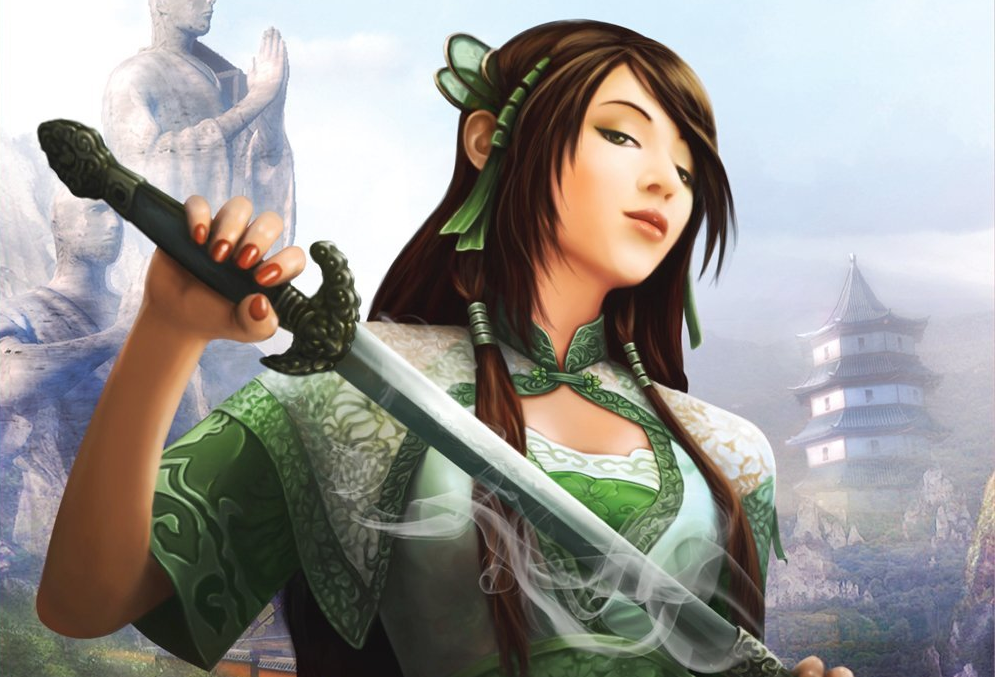
First up: courtesan and Jinyiwei Imperial agent, Lotus Blossom Mei:


"Lotus Blossom" Mei
  • Aspects
High Concept: Imperial Secret-Agent and Courtesan
Trouble: The heart must be held in secrecy
Other: Master Ling taught me everything; Beautiful viper; Trust no one
  • Skills
+4 Deceive
+3 Fight, Rapport
+2 Athletics, Chi*, Empathy
+1 Burglary, Investigate, Notice, Will
  • Jianghu Rank: 1* (Ghost Serpent Form)
Ghost Haunts the Shadow: You may use Chi instead of Stealth to create an advantage based on moving silently or remaining unseen.
Serpent Bites the Hand: If you gain shifts on a defense, you can sacrifice your action next turn to immediately inflict an attack on your opponent using the shift value of your defense as your attack result.
Serpent Strikes Twice: +2 bonus to Deceive rolls to create an advantage based on disorientation, distraction, or unbalancing against opponents you have already inflicted stress on this combat.
  • Stunts
The Scent of Jasmine: +2 to Overcome with Deceive when dealing with those who might find you attractive.
Resplendent Flower: Sub Rapport for Lore when dealing with matters pertaining to fashion and beauty.
A Hundred Flowers: Once per session you can call upon a helpful ally in the area, provided you can recount a story of your previous meeting.
  • Refresh: 2
  • Physical Stress: OO
  • Mental Stress: OOO
Consequences:
  • Minor (2):
  • Moderate (4):
  • Severe (6):
Special Ability Bonuses:
  • +1 Zone Movement, +1 Passive Opposition (Jianghu Rank 1)
  • Chi Armor (Chi +2, see Tianxia pg. 60)
Background:

Orphaned at a young age, Mei was taken in by Captain Ling of the Jinyiwei (Brocade-Clad Guard). Although Master Ling was like a father to her, he did not take her off the streets out of sheer charity: instead he aimed to train her as a secret member of Jinyiwei, who served as the Emperor’s feared secret police force.

Under a series of tutors Mei learned to read and write, sing and dance, and various other arts appropriate for a charming lady of high-society during the day: while at night Master Ling himself taught her the techniques of the Ghost Serpent school of martial arts.

At age 18 she was told to report to Madame Qi: trainer of Courtesans and herself a secret member of the Jinyiwei. Under Madame Qi’s watchful eye she learned to manipulate the hearts of men and those prey to easy flattery, while never forgetting the most important lesson taught her by Master Ling:

“Your heart is your greatest treasure: keep it secret, and never let anyone steal it.”

As a member of the Jinyiwei, Mei travels the remotest corners of the Emperor’s dominion, seeking to gather intelligence and bring to justice both criminals and corrupt officials alike, all whilst under the guise of ‘Lotus Blossom’ Mei : famed and much sought-after courtesan.

***

Although the Emperor has many judges and magistrates in his service, members of the Jinyiwei typically make very little use of them, having been authorized by the Emperor himself to bring any in all to justice without due-process or trial as they see fit.

Mei enjoys the full authority of any Jinyiwei member: when dealing with highly placed or influential individuals who could feasibly escape prosecution it is not unusual for her to serve both as judge and executioner when other means are not available.

***
"Lotus Blossom" Mei (Google Docs)

Tuesday, July 8, 2014

Review: Tianxia (Fate Core)

Format: Hardbound Book/PDF: 192 Pages
Publisher: James Dawsey
Author: Jack Norris
Art: Denise Jones
Map: Marco Morte
Editing: Nathan Kahler
Art Direction and Graphic Design: Daniel Solis, with Ruben Byrd
***

Launched via a successful Kickstarter campaign in October of last year (it seems like this is how you launch RPG's nowadays...), Tianxia is a wuxia setting and rules supplement for Fate Core.

Although I was instantly enticed by the style and presentation presented in the Kickstarter - the art especially, as the art is gorgeous..more on that below - I dawdled on contributing until November, and didn't really examine the PDF at length until about a month ago.

My thoughts in brief: if you already own Fate Core and you want to play a high-octane wuxia game, you owe it to yourself to at least check it out. If you are new to Fate and just want to play a wuxia game that supports all the tropes, then you should still check it out.

More details as to the why of this in my review below.

  • Presentation & Layout

My thoughts on Tianxia very much parallel what I had to say about Jadepunk in my review of that game earlier this year: this is a beautiful and beautifully laid-out book where the design really sells the genre and flavor of the game on every page.

This is also one of the blessed few RPG books where the reader is rewarded by reading it cover-to-cover, like a storybook: and indeed, we are given the story and flavor of the world of Tianxia well before the author presents the hard mechanics that make things work in play. 
  • Setting and Background
An except from the book sells the basic idea well:
"Tianxia (“under heaven”) is a series of rules and setting supplements for the Fate Core system. 
The title of the game comes from both the concept of all the lands and people in Imperial China existing under the purview of the gods and their celestial kingdom and the term used for the imperial unification of kingdoms and cultures to create a central “China” that had previously not existed. The films Hero (Jet Li, not Dustin Hoffman) and The Emperor and the Assassin present fictionalized but highly entertaining versions of how that unification began.  
Just as Tianxia the concept was supposed to include everything that existed “under heaven” in real world imperial China, Tianxia the game includes everything in our rules and setting materials heavily inspired by Chinese myth, legend, and modern media such as Kung Fu and wuxia literature and film."
What follows is a pastiche of what is the 'standard' setting for a traditional wuxia adventure: Jaingzhou, the wild west of this fictional version of China. The book explains that this is but one of the nine-provinces of Shenzhou (which itself is but another name for China), the other eight being promised in greater detail in later supplements.

Far from the grip of the capital, rule of law in Jaingzhou province is more of the 9/10th of the law variety: if you can hold it or steal it, it's yours. This is a place full of bandits, secret societies, corrupt officials, private security services: a land of corruption and injustice. A place badly in need of heroes.

In short: the perfect place to have adventures!

Everything you need to run a full campaign is here: loads of named NPC's, locations, and organizations to power your game: but enough white space to make it all your own.

Where the flavor text and character stats end, various sidebars inform the philosophy of the game designers, discussing matters like creating an inclusive gaming environment, possible adventure hooks and story ideas, and even the traditional role of eunuchs in Chinese culture and legend. All dandy here.
  • Rules & The Deadly Arts of Kung Fu
Although Fate is often presented as a 'story game', Fate Core in particular has a lot of bits to define character competency via Skills and Stunts. Tianxia expands upon this by adding a new Skill, 'chi', and a new way to build martial arts abilities via the Forms system.

An important note here: although it does contain 192 pages of wuxia goodness, Tianxia is NOT a complete game system. You very much need Fate Core to play it and build complete characters: even the action resolution tables are missing from the book.

As stated in the intro, I participated in the Kickstarter and was already playing Fate Core when I picked this up, so this wasn't an issue for me. But this basic point is not mentioned in either the front or back covers, and appears for the first time under 'What Is This Book' at pg.16. I can easily see a new gamer overlooking this factor, even upon relatively close inspection.

So if I picked up this book after flipping through it at the FLGS and discovered this when I got back home and not already in possession of Fate Core..I could imagine being a tad upset. Maybe a niggling point since Fate Core is currently a 'pay-what-you-like' (including nothing) PDF download, but it's my one complaint about the physical book.

But let's talk about the good stuff!

In addition to the 18 Skills presented by Fate Core, Tianxia presents a new one: Chi, the quasi-mystical force that represents the body's flow of energy. The actual concept of chi (or 'ki', or 'qi') is complex and tied to Chinese Daoist thought...but here it's a kind of super-power that gives characters greater physical/mental endurance and recovery abilities, as well as expanding what the character can do in conjunction with their Forms and Stunts.

Forms are really neat. For those already familiar with Fate but not Tianxia in particular, it's best to think of Forms as specialized (and discounted) Stunt packages.

For example: the character Smiling Ox (character sheet below), is trained in the Iron Tiger Form. Per the book:
"The dreaded Iron Tiger practitioner is thought to be one of the most aggressive, lethal fighters around. 
What Iron Tigers lack in maneuverability and flexibility they make up for in physical power, toughness, and aggression. This style eschews many of the tactics and principles of softer styles to focus purely on hard-hitting blows, disabling strikes, painful locks, and linear but effective defenses."
Each form is also an aspect that can be invoked/compelled like any other aspect in Fate. Taking a form has cost involved, in terms of Refresh (your starting Fate Points): one point of Refresh (or Stunt slot) gives you the form and one Technique (worded as pre-generated Stunt). Each additional point of Refresh spent on the Form grants two more techniques.

Like the Iron Tiger Form above, all Forms consistent of a element (Iron, Storm, Forest, etc.) and an animal (Tiger, Monkey, Dragon, etc) that flavors and informs your martial arts style.

There are additional rules that grant certain benefits when you master certain Forms, which I won't get into here. Bottom line is: although this is an optional system for character creation, I cannot imagine NOT taking a Form if you are playing game where physical conflicts are going to come into play. They are just too powerful to be ignored.
  • Sample Characters and GM'ing
The GM'ing section starts out sprightly, with a handful of sample characters emulating certain tropes (I recognize Detective Dee and Princess Mononoke as templates- I'm sure more informed readers will spot others). This leads into a sample play session starring these characters, to demonstrate how Tianxia character builds work in play. 

This then leads into the standard GM advice section, some comments on legendary weapons (standard Fate rules: if gear is important to the story, model it. If not, it's just flavor), story advice and more plot seeds, and a 'bestiary' of standard and exceptional NPC's that can be encountered in play. 

All of this is followed by four simple - but well-plotted - two page adventures to run your new characters through.

Like the rest of book, these sections are presented in informative (but not authorial, in the bad sense of the word) way, and all the material is easy and fun to read to boot.

  • Inspirations and Afterword
Much of the final 20 pages or so (about a tenth of the book!) are taken up by listing inspirations from films, books and video games. At first blush this might seem like an excessive use of limited space, but it's clear that the author (Jack Norris) wants to provide this because:
  •  It's good to know where he is coming from in terms of game-design and play
  • He wants you to have plenty of sources of inspiration for your game as well.
For my part, I've seen four of the eleven listed films, am familiar with (but have not read) two of the four listed books, and I've played two of four listed games. Personally I would have added the two Zu Warriors films to the mix, as well as Iron Monkey: but it's not my book.

Author Jack Norris' afterword is nice too, noting his personal journey to finally getting this game published after a decade plus. This has clearly been a labor of love for him, and this absolutely shows in the finished result.
  • Final Thoughts
So the book looks nice, has great content, and an interesting system to build kung-fu powers: but does it work well in play?

Well, I've recently been GM'ing a game using the system recently and I can give the affirmative to that: abso-friggin-lutely yes it runs great in play! My players have been having a fantastic time exploring their various kung-fu powers, and as GM I've had a blast coming up with scenarios to challenge them.

Now, this is still Fate - the roleplaying aspects of portraying characters at the table are still important - but thats true of any good RPG, Fate included. What Tianxia brings to the table are the extra bits, and those extra bits are fun and don't bog down gameplay at all.

Is it worth your gaming dollars? Well....that depends. It's a nice coffee-table book - the art and presentation are great, as noted above - but at $44.95 (USD) it's pretty steep investment for a book that won't ever be played. And this is a game that wants to be played.

If you are already gaming with Fate Core and have been thinking about playing a wuxia game: then yes, it's worth the investment. If you prefer playing from PDF's (or just don't want to pony up for the hardback), then that's just $14.99 on DriveThruRPG. 

If you aren't familiar with Fate Core but think playing a high-octane (but still story-driven) wuxia game might be fun, I would suggest you download and read Fate Core first (available as pay-what-you-like/free price-point), before investing in either the PDF or the hardback for Tianxia. Tianxia takes what Fate Core offers and builds on it: if you don't like or grok Core, you will have the same trouble with Tianxia.

***

More on the blog soon about our Tianxia game here in Seattle: The Kingdom of Xinjou!

***

Friday, July 4, 2014

Avengers Accelerated: The War (part 2/5)

Joss has six players who want to participate in a supers game, called Avengers Accelerated, that uses the Fate Accelerated Edition rules. The participants are Tony, Steve, Clint, Natasha, Bruce, and Thor. Joss's adversary character is Loki, backed up by the invading Chitauri force (created as a character using the Fate fractal). New York City is also built as a character.

I'm using FAE stats for all the Avengers, posted here. The sheets include aspects, approaches, and stunts.

You can reread Part 1 of the session, or continue to Part 3Part 4, or Part 5.

During the last session, the team finished the first exchange of a conflict. Tony took 2 stress and spent 1 Fate point, and New York City had taken 2 stress from the Chitauri attack. On the bad guy's side, Loki and the Chitauri are both down 1 stress. Tony created the aspect It's All On You on Loki, with one free invocation. Steve created Containment Strategy as a scene aspect, with two free invocations.

----

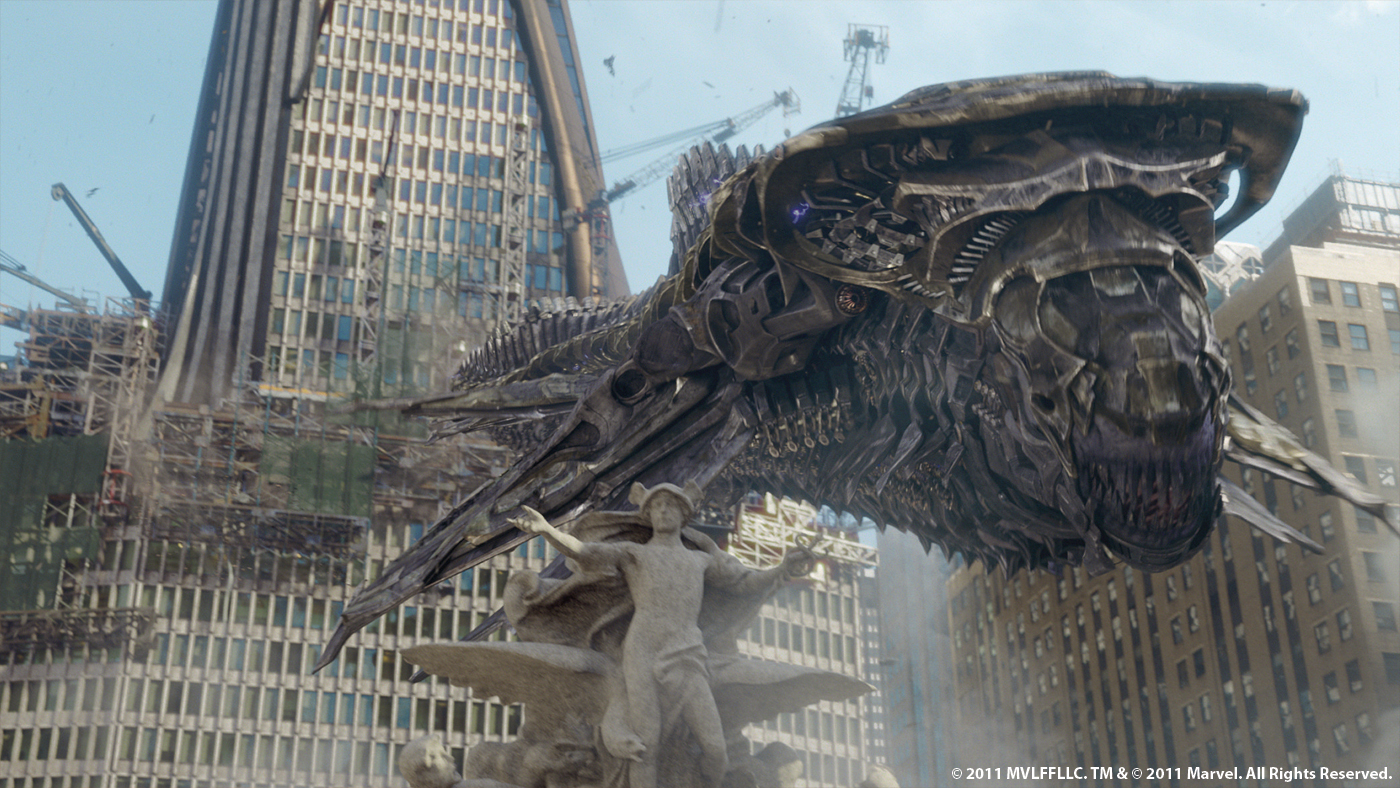
Joss: "Last time, the Chitauri war machine had been coming through the gate over the Stark Tower. Now the gate is disgorging these huge cybernetic flying serpents. They're smaller than the helicarrier, but they look at lot nastier. You notice it's also serving as a troop carrier - hundreds of Chitauri soldiers leap out from the sides of the beast, and cling to the walls of the skyscrapers here. You can call them Leviathans, to stop you guys from making up any goofy names. Steve, who goes first?"


Steve: "Tony. He's already flying, so maybe he can fight that stuff. I'll call him on the radio to alert him."

Tony: "That thing is huge. It looks way too big for a guy in a suit to take on solo, so I'll have JARVIS scan for weak spots."

Joss: "Okay, it sounds like you're Cleverly creating an advantage. Roll it."

Tony: "I succeed. I'm creating Weak Spot on the Chitauri. Can you give me any details on that?"

Joss: "You can see what look like living eyes underneath the metal carapace. You'd guess these are alien cyborgs of some kind, so the living tissue is their weak spot. You'd need to find a way to get to that, though."

Aside from giving mechanical bonuses, an aspect is true. The specific nature of the Chitauri vulnerability will come into play in the next few rounds, when Tony, Thor, and Bruce all work on the Leviathans.

Tony: "Thanks. Thor going next worked great last time, I want to see what he does to Loki."

Thor: "Joss, Loki is still my brother. Yeah, he's adopted, but I have a duty to him. I'll tell him to look around, and try to convince him that this is madness. I'm offering a compel on his aspect Thor's Overlooked Brother. Because I have a stunt about showing my enemies mercy, I don't spend the Fate point if he accepts."

Joss: "Loki looks around, seeing the carnage he has wrought. You see the haunted desperation in his eyes as he tells you it's too late to stop it."

Thor: "I'll say: No, we can, together. Does he accept?"

Joss: "For a moment, you think he might.. and in that moment, you feel one of his sharp blades stabbing you in the guts. 'Sentiment,' he hisses, but the look on his face doesn't convey conviction, only trapped fear. You'll get a Fate point at the end of the scene."

Compels are a valid way to end an encounter, or at least remove one combatant. In this case, Thor wants to take Loki out by appealing to his better nature, and had a stunt making this an affordable option for him. Even when it doesn't work, as in this case, the refusal costs Loki a Fate point from the GM's pool.


Thor: "I had to try. That's not my action, right? If not, I'll attack. I'm enraged at his senseless refusal to come back with me and the destruction he is causing. Because I wield the power of Mjolnir, I get a +2 to Forcefully Attack."

Joss: "You still have your action, yes. With that attack roll, and Loki's defense, you'll hit. He chooses to take a Minor Consequence. He's not going to want to stay in this fight, since you've always been better at beating things up, so he'll try to get away after this. Any suggestions?"

Thor: "I don't want him to try and mind-control anyone else on the team, but I'm fine if he runs away for now - that's his nature. I want to break that scepter."

Joss: "It might be useful to you guys later - you might need it to break Selvig out of his mind control, for example. How about instead he drops the scepter in his haste to run away, and he rolls off the edge of Stark Tower and catches a ride on one of the Chitauri flyers?"

Thor: "Sounds good. He's always got a plan - he won't just run away without an idea of what to do next, and I want to see what that is. So Loki's up."

Joss: "Alright. Loki takes Scepterless and Running. He landed on one of the flyers, and he's taking direct control of his troops. He's rolling to overcome It's All On You by showing himself in the thick of the fighting and bolster the Chitauri's confidence in him - and probably his own too. Thor hit a nerve earlier, but with that roll he succeeded. I'll give your ground team time to set up before the Chitauri attack next, so Clint is up."

Loki doesn't want the team to try and compel the aspect Tony created, since another refusal would cost him more Fate points. The cost to wipe it out is one action in the conflict, which he finds acceptable.

Clint: "Steve, Natasha, and I are taking cover on the ground. We probably see civilians trapped by the aliens here, right? New York was taking a beating last time. We have to rally them. Steve, we'll set something up to keep the Chitauri busy. Get going and help the civilians when your action comes up."

Joss: "Okay, what did you have in mind?"

Clint: "We'll start firing at the Chitauri, trying to draw their attention away from the civilians. If there's people trapped in the cars they've been blowing up, we'll try to rescue them when we have a few seconds, that sort of thing."

Joss: "Sure. In fact, there's a bus full of civilians. You gets to work helping them out while Natasha's making precision shots with her pistols. Not much penetrative power against their armor, but if she aims at the right spots, you guys can make a difference."

Clint: "Okay. Can we call this an advantage? I'm rolling to ensure that We've Got Steve's Back."

Joss: "Sure thing. That's a success, so you've got a free invocation."

Natasha: "Okay. Steve is up next."

Steve: "I'm better on defense. Joss, the rules say I can roll a Defend action on behalf of another character. Can I do that for all of New York City?"

Joss: "How did you have in mind?"

Steve: "You said they were rolling We're Civilians earlier, but their better approach is Our Town. Well, I'm Captain America. If I can rally the cops and get them coordinated using my soldier's skills, is that enough to shift the approach they are rolling?"

Joss: "Sure. You'd still need an aspect on the ground that justifies your defense rolls. I'd accept Containment Strategy, or you can roll to create another one now. A Defend action will happen on the Chitauri's turn, not yours, so you can still put down your Cap-is-here aspect to give NYC the more advantageous approach."

Steve: "Yeah, creating another advantage sounds better for right now. I'm going to dash down to the civilians, and the Chitauri are probably shooting at me too. I dodge some laser blasts to a bus and jump down to the roof of a car. They shoot the car, which flips forward, and I use that to propel myself faster. They'll see me coming and hopefully get some confidence that somebody is taking a stand. My roll was average, but my tactical acumen as a professional soldier gives me a +2, since this is a large group I'm working with."

Joss: "Okay. With that roll, how about an aspect like Rallying New York?"

Steve: "I like that! Okay, Natasha, wrap up our ground team efforts."

Natasha: "I like the banter that Hawkeye and I have been having, and he still needs to get back to his old self after being mind controlled. Joss, we're basically supporting each other with cover fire, just like the good old days. We go way back. Can I make some kind of teamwork advantage that reflects that?"

Joss: "Don't see why not. Roll it."

Natasha: "Okay. I'm bolstering Clint - and honestly, myself - by talking about the old days. Like how this feels just like... Budapest."

Clint: "You and I remember Budapest very differently. Yeah, I like that. How about Back-to-Back Badasses?"

Joss: "That's the spirit! With that roll, you've got a free invocation."

The ground team has created several advantages to support the relatively weak New York City, since losing it means losing the fight. The aspects they create reflect their respective back stories and character relationships, rather than being empty combat bonuses.


Clint: "Okay. Let's let NYC take its action."

Joss: "New York is trying to get organized. They roll to create an advantage, but even rolling Our Town they blow it. The Chitauri will attack New York City again."

Steve: "I'm intervening to defend on their behalf."

Joss: "Okay, tell me what that looks like."

Steve: "Earlier you said there were some cops on the ground who weren't sure what was going on. I'll hop onto the roof of a car in front of those two and tell them to execute my containment strategy. Get cops up into the buildings to rescue civilians, set up a perimeter, that stuff. One says, 'why should we listen to you?' Just then, some Chitauri soldiers attack me. I block their blasts with my shield, punch them out, and even rip the weapon arm off of one of them. They're dismantled in seconds. Using my star-spangled shield should qualify me for the stunt, for +2 to the Defend roll."

Joss: "Awesome! The cop immediately grabs his radio and repeats your containment strategy word-for-word to the rest of the force. Your good defense roll earned a boost, but I'm giving that to the New York City character instead of you. We'll call it Perimeter Established. And with the successful defense, the Chitauri's ability to injure civilians and destroy property are limited by the cops, and your team's efforts. You still have that Leviathan flying around, and Loki's running things from on high."

Steve makes good use of the rules and his bonuses to Defend, by protecting the relatively vulnerable New York City. His intervention gave the city a much-needed bonus.

Tony: "Is that Leviathan a separate character?"

Joss: "Hmm... We'll say no, but each Leviathan in play adds two stress boxes to the Chitauri force. This one can be attacked by anyone who can fly for right now. You can tackle it on the next exchange if you want."

----

Stay tuned for the next session of Avengers Accelerated!

Wednesday, July 2, 2014

I Kissed a Pathfinder..and I Liked It (Pathfinder)


If you have been following this blog - and if you have, thank you! - you will be no stranger to my personal ambivalence towards d20 based games.

Why ambivalent? Well, like most of my generation, I started in this hobby by playing D&D; the original d20 game, back before d20 became a thing-unto-itself. So for me, d20 is the baseline by which all other games evolved outwards from. I can't really hate d20; d20 is my roots, after all. And within it are the basic building blocks for the hobby itself.

But...I've moved on, right? I have other, more advanced - more modern - game systems to play. Fate! Dungeon World! If I want a crunchy d20 game to play, I can spy Fantasy Craft right there on my shelf, waiting to be explored.

Plus, I've played a D&D 3.5 game, and I found the whole experience utterly lamentable. The basic problem was we had GM who was utterly committed to playing the game RAW with no exceptions: but really, if any game played RAW is a dull game, then it's just a bad game system. Right?

Right.

But...well, then there's Pathfinder. The sexier younger sister to D&D 3.5, with the beautiful art and presentation, with the legendarily well-written and flavorful modules ('Adventure Paths'), play-tested and fan-supported, all wrapped up in a cute little bow by local Seattle-area gaming studio Paizo.

Pathfinder always intrigued me. But not enough to play the damned thing. I flipped through the main book, and the modules, and the innumerable splat books with interest and appreciation..and then put them back on the shelf of my FLGS. Great stuff guys...but no thanks.

Flashback to 2012: looking for some gaming aids for my ongoing Fantasy Craft campaign, I stumbled across the Pathfinder Beginner Box. Complete with a playmat, some artful 'pawns' (cardboard miniatures), and set of dice, for just under $30.00? Sure..why not!?


And my gaming group used the hell out these tools: the dice rounded out my polyhedral collection well, and the map and pawns got plenty of use in our Fantasy Craft campaign. As for the rest - the character sheets and pregens, the Game Master Guide and Heroes Handbook- these stayed in the box as curiosity. Flipped through, but unread and unused.

Flash-forward to 2014. It's 8am on Saturday morning, and I'm packing up my stuff for Go-Play NW 2014. Gary has a supers game set for the day...but I've got nothing at all prepped to run. My eye spies the Pathfinder Beginner Box, and I think: sure, why not? If we have a spare moment during the day, I can run this. Easy-peasy.

Long story short: such a spare moment appeared, and I wound up running a game using the Black Fang's Dungeon scenario from the book. The result? I loved running it, and my group had a great time enjoying an old-school dungeon-crawl.

Before we go any further, note that I made some minor rules modifications before we even got started:

  • I failed to bring the playmat and minis, so movement and range were made to be largely narrative: Close (melee range), Near (penalty-free ranged attacks) and Far (ranged attacks at -2). Characters were allowed to move one 'zone' for free, or two by giving up an action.
  • Skill use was based on narrative justification: if you could justify the use of the skill, it was valid. If the book said 'Knowledge: Religion' was needed for the check, then 'Knowledge: Arcana' could sub as well.
  • Penalties for firing into melee combat? Attacks of opportunity? All narrative: the GM says when this stuff matters. If it slows things down or makes the experience suck..it doesn't matter.
  • You had to narrate what you were doing to do it. Attacking a goblin? Tell me how you are doing it! You succeed and kill a goblin? Narrate that shit: I want some cinematic flavor at my table, or it's all just boring numbers.

In short, I was running the game using Pathfinder mechanics to modify rolls, but acting like I was GM'ing a game of Dungeon World. And it worked like a dream, and fun was had by all.

What's the take-away from this experience?

For me, it's that any game system can be fun, provided that everyone - players and GM included - are committed to having fun. The minute that any rule gets in the way of that, that rule should immediately be abolished or ignored. 

Secondarily - but just as important - don't ever think of the players as agents that derail your story. They are there to contribute to the story. The players will do things not imagined by you or the module's designers: in this case, improvise!  

In the case of this module the scenario suggested either a resolution as a physical conflict or a diplomatic one: in reality, it was both with the players slaying King Fatmouth and interrogating a charmed goblin;  I chose as GM to provide the 'diplomatic solution' info via the charmed goblin, as this seemed the logical reward to this cautious approach. The story was thus adjusted based on player initiative, rather than being derailed altogether. 

So will I be running more Pathfinder games in the future? 

Sadly, the answer to this seems to be 'no'. My gaming group prefers the flavor found in newer - and more narrative, and flexible - game systems like Fate: as soon as I suggested we play Pathfinder ongoing the conversation led to talk of Fate Freeport being used for fantasy gaming. Which is great: I loves me some Fate gaming.

So for now, Pathfinder will have to live in inside of it's little Beginners Box, unloved and hardly played. But we did have a moment, once.

And I liked it. 

***

Tuesday, July 1, 2014

Avengers Accelerated: The Invasion Begins (part 1/5)

Joss has six players who want to participate in a supers game, called Avengers Accelerated, that uses the Fate Accelerated Edition rules. They've done several sessions already, and Joss is getting everyone warmed up for the big final combat. The participants are Tony, Steve, Clint, Natasha, Bruce, and Thor.

Sample FAE stats for some of the Avengers as done by Ryan M. Danks can be found here.

During the last session, the team went through several climatic and heart-breaking revelations. The villain Loki's plan is coming to fruition, and now only the Avengers can stop him!

You can continue to Part 2Part 3, Part 4, or Part 5 of the session.

D. Willhite annotated these into a single document, with rolls and other mechanics highlighted. You can find it here.

Bruce informed Joss earlier that he'd be late, so the group agreed that Hulk would be thrown clear of the SHIELD helicarrier and wouldn't be able to make it back for awhile. The group continues without him.

----

Joss: "The cosmic cube is charging up on the Stark Tower rooftop. Tony has realized Loki's plan involves the arc reactor on his tower, and is flying there at top speed - or what passes for top speed, given his damaged armor."

Tony: "Okay, what do I see?"

Joss: "You see the cosmic cube - and Doctor Selvig. The cube is contained in some sort of elaborate device which is glowing with arc reactor power, or maybe Tesseract power. It's hard to be sure. Maybe your dad's design for the reactor used the Tesseract after all. JARVIS tells you he already shut off the power and that the reaction is self-sustaining. Selvig confirms it, and from his rambling you'd guess he is still under Loki's control."

Tony: "I blast it."

Joss: "You're knocked back by a force field surrounding the device - JARVIS tells you it's impenetrable to your repulsors. Nearby, you see Loki."

Tony: "Okay, Plan B. Joss, how are we staging this fight? Last time, we established that Loki was focusing this conflict on us vs. him to get the world's attention. But he's got an army. We can't knock off a thousand stress boxes."

Joss: "The army is coming, I'll explain when they show up. For now, it's a Conflict. You can try to attack Loki. You can attack him physically, mentally, or socially. You'll also be fighting off the Chitauri, and if you focus on Loki they will level the city. We're using Dramatic Initiative, so each player decides who goes next. In each exchange, the NPCs must also go."

Tony: "Alright. Since I got here first, I'm going to threaten Loki! Make it clear that I'm not impressed with his plan. I'm Iron Man - I'm fighting him ego to ego. This is a social conflict. Plus, my suit is damaged. But as my minor milestone for last session, I'm upgrading my aspect to Iron Man Suit Mark Seven."

Joss: "Sounds good - you guys trade menacing threats and witty banter. What's the effect of this?"

Tony: "This is more speaking with conviction than showing off, but I think this level of ego deserves Flashy, I'm taking on a god here. I want to Create an Advantage."

Tony's strategy is to engage the god verbally, rather than physically - wise, given the damaged state of his armor and how Tony fared against Thor in an earlier session. In FAE, PCs and NPCs have a single stress track instead of separate physical and mental tracks, so all forms of attack are equally effective.

Joss: "Okay. Based on that roll, you succeed. What aspect did you create?"

Tony: "How about It's All On You - He made it personal for us, I'm making it personal for him. He blows this, he'll have nowhere to go. Loki's turn - he's right here, he's the logical next actor."

Joss: "You got it. Loki makes a counter-attack. Since this is a battle of wills, he's attacking in kind. He's going to try and take over your mind with his scepter. If he's able to inflict a Consequence on you, he can compel it to control your mind until the Consequence wears off. Roll a defense."


Tony: "My defense roll was bad. Clint was a pain to deal with, no way am I making the team fight me too. To avoid taking a Consequence, I'm invoking my Cybernetic Heart aspect - he taps people in the chest to take them over, right? You've already hinted that the Tesseract power and my arc reactor are related. So let's say his scepter's power is blocked by my implanted arc reactor."

Joss: "Fair enough, in that case Loki's attack only inflicts two stress. He's not going to take this failure lying down, so he grabs you by the throat and throws you out the window! This won't kill you, but tell me what happens."

Tony: "I'm wearing my bracelets to summon the Mark Seven armor, so it wraps me up as I fall. Just at the last second, I'm suited up and able to fire my repulsors and jet back up to where Loki is. I blast him in the chest - for Phil."

Joss: "Very good. Alright - the Chitauri wormhole is opening. You see armies of bad guys pouring through it. They are riding hover-bikes of some kind. Since there's far too many enemies for any of you to handle even as a team, we're going to treat the entire Chitauri attack force as a single NPC. It's got one aspect, Invading Chitauri Force, and can take stress. It rolls Large-Scale Attack at +4, and Showing Initiative at -2. They won't be pushovers, but they're not too smart on their own. Against it is New York City itself as another character. Its aspect is The Big Apple, and it rolls Our Town at +2 and We're Civilians at -2. Since it's a whole city, it can take Consequences as well as stress. Your job is to keep that from happening. If the city is Taken Out, you failed."

Joss sets up the conflict using the Fate fractal, by defining both the invading army and its target as characters in their own right. This makes nine participants: the six PCs, plus Loki, the Chitauri, and the city. This will be a large fight, but hopefully not too unwieldy. The fractal characters aren't mooks, but NPCs in their own right. The Chitauri don't take Consequences because they are being gradually whittled away, but New York City can become worse and worse off in specific ways.

Tony: "Right. Army. Alright, I'll head up there and start attacking them as they come, leaving Loki alone for the moment. Let's get the Chitauri's action out of the way."


Joss: "Okay. On the ground, the Chitauri are swarming everywhere. Lasers are blasting, explosions are happening, cars are being destroyed. Civilians are running for safety, but they are panicking and unsure. The Chitauri are attacking New York City. Based on these rolls, NYC takes two stress. On the roof, Loki changes into his armored form. Thor, you're next on the scene. What do you do?"

Thor: "I'll take my shot at Loki now - it's going to be a knock-down, drag-out slugfest! Bruce gets the best Attack bonus, so for right now we should whittle down Loki's stress boxes before he can set up some advantages - we'll need Hulk's attack to be as effective as possible. Assuming he shows."

Joss: "Excellent. You and Loki start trading punches! He's got his scepter, and he can blast at you. He's fighting sneaky like usual. Roll your attack."

Thor: "Forceful, naturally!"

Joss: "Naturally. Dice look good. Loki's defense also looks good, though. You inflict one stress. You're hurting him, but he's not staying down. Who goes next?"

Thor: "I want to see what New York City does this round."

Joss: "Sounds fine. Based on that roll, they do jack - they have to roll We're Civilians against an army to try and organize an effective defense. On the street, the police are starting to show up to respond to the chaos, but they're pretty ineffectual. On the ground, a couple of cops are arguing about whether the Army, or anyone, knows what's going on here. Natasha, Steve, and Clint will arrive in the Quinjet. Decide amongst yourselves who goes next."

Natasha: "I'll go. Tony is flying around crazily, fighting the ones in the air, right? Let's say I use the Quinjet's cannon to shoot some of them down, with him leading them to me. We'll shoot from cover into an ambush type situation, so that's Sneaky."

Joss: "Good roll, you inflict one stress on the Chitauri. As Tony leads a bunch of the soldiers past your position, you blast them from a side-street, and their hover-bikes blow up and take them out. Who's next?"

Natasha: "We'll have Clint go next."

Clint: "We're near the Stark Tower, so I'll fly over there and take a shot at Loki with the Quinjet's cannons. I owe that son of a bitch some payback! Here goes."

Joss: "That was a terrible, terrible roll. You're still off your game from the hit on the head Natasha gave you, and emotion clouds your aim. That said, I don't like the idea of you just missing, since you're supposed to be awesome with ranged weapons, and Loki's going to get a boost from his defense since he succeeded with style. Would you trade a major cost for him not getting that boost?"

Clint: "You bet! How about he blasts us back, and the Quinjet crashes?"

Joss: "That's what happens. You guys go down, smoking, and crash hard, but nobody is hurt. The jet is scrap, though. You won't be able to attack Loki until you get back into range with him."

Thor: "I'm still in melee with him. I'm angry he shot down my friends, so I'll smack him around for that."

Joss: "That's fine, the fight continues! Steve, you're up by default. What's your action?"

Steve: "Head out of the crash, and try to get a sense of the situation. I'm using my tactical acumen and years of war experience to try and figure out a plan of attack here. We'll need to coordinate and deploy our forces so I'm preparing to do that."

Joss: "Okay, we'll call that Creating an Advantage. Roll it."

Steve's choice of action was dictated by Clint's earlier attack. He can't directly attack Loki now, so he settles for creating an aspect using his strengths as a character to help deal with the oncoming Chitauri.

Steve: "I succeed with style. I'm creating an aspect called Containment Strategy."

Joss: "Sounds good. That concludes the first exchange."

----

Stay tuned for the next session of Avengers Accelerated!

Friday, June 27, 2014

Four-Color FAE: Supers Gaming via Fate Accelerated - pt13


Tomorrow is Go Play NW here in Seattle, a convention for RPGs and story games. We here at Station53 play to run an introductory adventure of Four-Color FAE, both because we love it and because it will be a great avenue to see how players, both experienced FATE players and those new to FATE, grok the rules. In particular, I want to see how easy it is to understand the power permissions concept. +Gary Anastasio has a Golden Age adventure prepped, which he describes as a "high octane classic superhero smack-down". We created a number of riffs on the classic archetypes of the era ready to go a pregens.

Next week we'll have a recap of that session, but for now, here's the characters we'll bring to the table (and links to each character's sheet):


High Concept: The man of tomorrow...today!
Hero analogue: Golden-Age Superman


High Concept: Patriotic action hero fighting for justice
Hero analogue: Captain America


High Concept: Crusading Valkyrie Battle Leader
Hero analogue: Wonder Woman, Thor


High Concept: Stage magician turned amateur sleuth and crime-fighter
Hero analogue: Zatara, Doctor Thirteen


High Concept: Wise-Cracking Socialite Turned Crimefighter
Hero analogue: Batman, Golden Age Sandman


High Concept: Blue-Collar Elastic Crimefighter
Hero analogue: Plastic Man


High Concept: Jet-propelled freedom-fighter
Hero analogue: Hawkgirl


High Concept: Powerful Protector Of The Wilderness
Hero analogue: Bigfoot!!  (also, The Hulk)


High Concept: Headstrong Princess of Lemuria
Hero analogue: Namor, Aquaman, The Little Mermaid (per +Mike Lindsey)


High Concept: The world’s greatest detective! (and his sidekick)
Hero analogue: Green Hornet and Kato, Batman and Robin


High Concept: The Fastest Man Alive!
Hero analogue: The Flash


***


Thursday, June 26, 2014

The Tao of Fate: Challenge, Contest, or Conflict?

It's not always obvious how to stage a particular dramatic encounter in Fate. The game provides tools, such as rules for Challenges, Contests, and Conflicts. To pick the right tool for the job, I think of three things: stakes, momentum, and exit points.
----
Stakes

For every encounter, start by asking: what's really at stake? What do the PCs get if they win, and what do they lose if they fail?

Something that would end the story on failure is never a good stake. Usually, this includes "the lives of the player characters", outside of a deliberately lethal conflict. If that's really what's on the line, you should rethink what the PCs are fighting for. Wherever possible, the stakes should reinforce the story being told, and they should be appropriate to the genre of your story.

If Superman is rescuing a crashing jetliner in his own comic book, and Lois is on it, then you can be pretty sure that Lois Lane isn't going to just die, because that will be jarring for the readers of a Superman comic book. Something else must be at risk. If Lois was injured badly enough in the rescue, would Superman be distracted from something more important? Would a villain be able to advance his plan further if the Man of Steel was in the hospital sitting by Lois' bed? Balancing his responsibility with his humanity is a core part of Superman's story, and those sorts of stakes reinforce his nature.

Changing Stakes

Sometimes, the stakes only become apparent as the encounter resolves itself. In "Blade Runner", during the final fight between Deckard and Roy Batty, Roy is already dying, and he knows it. Over the course of the conflict, the real stakes are eventually revealed: does his life matter? Will he leave behind any sort of legacy? Deckard is the last chance he has to make that happen. The stakes for Deckard seem to be his own survival, but they shift to protecting his identity. Can he keep being who he was? Does he want to?

If your group realizes that something has changed, it's perfectly legitimate to stop the currently running Challenge, Contest, or Conflict, or to reframe it in the new terms. In the Deckard vs. Batty Example Fight from Richard Bellingham (discussion thread here), this is exactly what happens, as the physical conflict becomes a mental one.

Momentum

In "Indiana Jones and the Temple of Doom", Indy, Willie Scott, and Short Round are riding the rails in mine carts. Their goal, of course, was to avoid the villain's henchmen and get out of the mines safely. Shorty was explicitly told which route to take.

Did they go that way? Of course not!

Did failing to go the right way end the story? Of course not.

A good encounter works like a mine cart ride: no matter where you go, you have to keep moving. Like mine carts, a story is always worse if it derails than if it takes a new route. Don't fear failure - instead, fear not having a new direction to offer the group if the dice don't work out.

Exit Points

So what should you use - a Challenge, a Contest, or a Conflict - to model an encounter? For me, it depends on the ways the participants can leave it. Do these exit points center around the stakes (Contests), the participants (Conflicts), or the situation (Challenges)?

Contests have twists and turns, as rivals try to outmaneuver each other, but you're all still heading toward something or away from something. Everyone exits the encounter when one or another got where they wanted to go.

In a Conflict, exit points always come at a cost. Nobody makes it out in the same shape they came in, unless they bought their victory with hard work, effort, and good fortune. Even concessions carry a price.

In a Challenge, there's many ways to exit the encounter, with the PCs winnowing down the possibilities. Sometimes they get the outcome they most want. Sometimes they compromise. Sometimes they're left with a terrible choice. But the exit point they get to use is one they can afford with their resources of skill, Fate points, and luck.

----

Challenges, Contests, and Conflicts are tools. They offer a way to challenge your players and provide a believable, if sometimes surprising, outcome. Once you have a sense of what the PCs are risking, and an idea of how their actions will carry them from scene to scene, you will be able to choose the right tool for the right job.